How to play Klondike Solitaire
Klondike is the classic solitaire most people first played on a computer, and the game at the top of this page. Your goal is to move all 52 cards onto four foundation piles, one for each suit, in order from Ace to King.
The goal
Build four foundations, one per suit, each from Ace up to King. To get there you sort the cards in seven columns and turn over the cards hidden in them. You win the moment the last King goes up.
Setting up
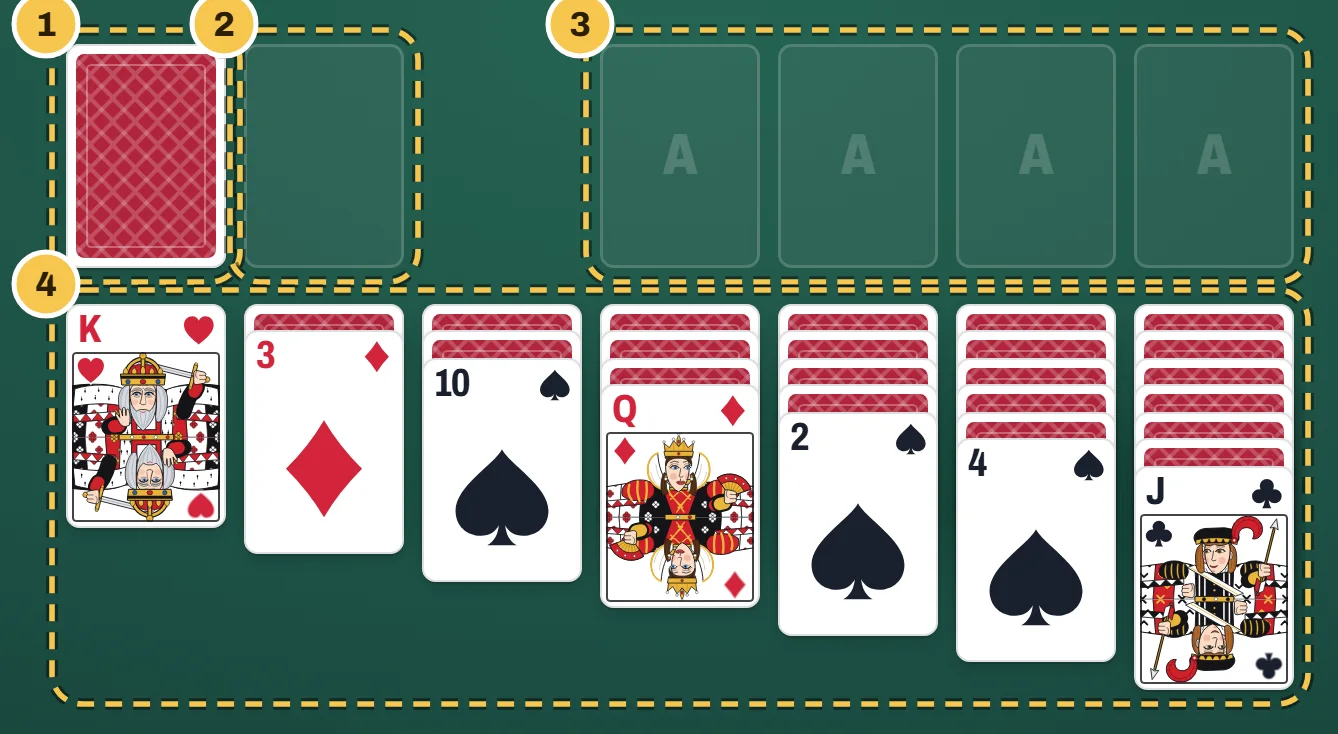
- The columns are dealt from left to right: one card in the first, two in the second, up to seven in the last, 28 cards in all. Only the top card of each column is face up.
- The stock holds the 24 cards left over, face down.
- The waste is where cards from the stock are turned face up.
- The foundations start empty. Each one takes a single suit, starting with its Ace.
- The deal is the same in Draw 1 and Draw 3. Only the way you turn over the stock is different.
How to play, step by step
- Send Aces up. An Ace can go to any empty foundation. Then build that suit up in order: 2, 3, 4 and so on to the King.
- Build down in alternating colors. In the columns, a card goes on one rank higher of the other color. A red 6 goes on a black 7, and a black 6 on a red 7.
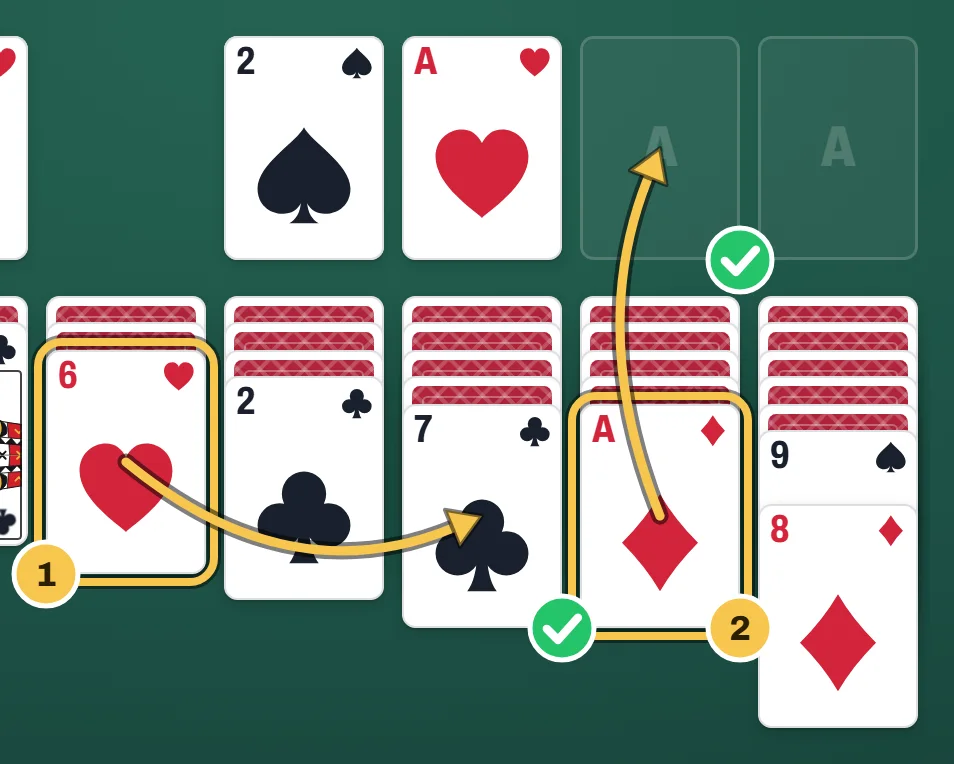
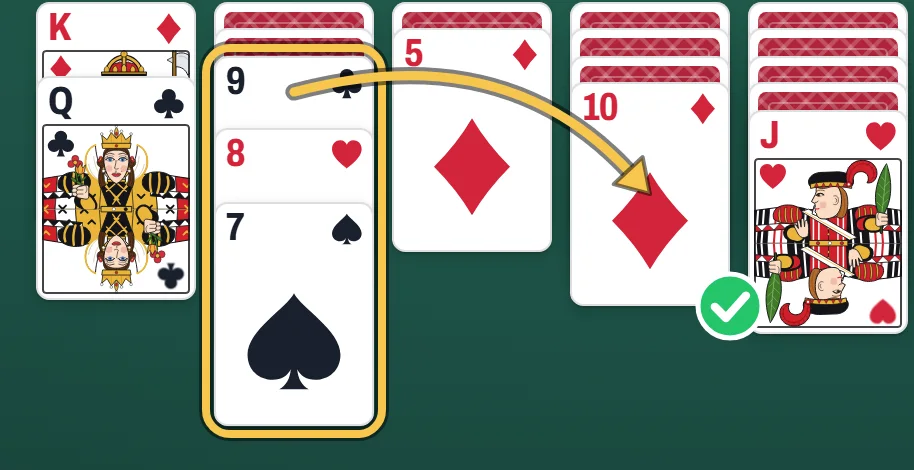
- Move runs as one. Face-up cards in order, like a black 9, red 8 and black 7, move together. The first card of the run has to fit where it lands.
- Turn over hidden cards. When the last face-up card leaves a face-down card, that card turns over and can be played.
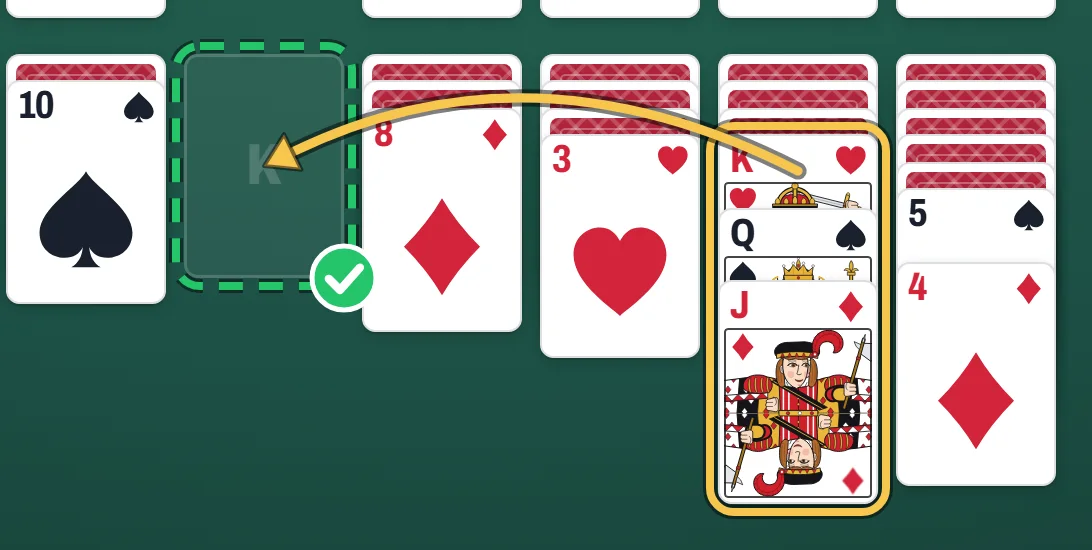
- Fill empty columns with Kings. Only a King, or a run that starts with a King, can go into an empty column.
- Use the stock when you're stuck. Tap the stock to turn cards onto the waste: one at a time in Draw 1, three in Draw 3. The top waste card can go to a column or a foundation.
- Go round again. When the stock is empty, tap it to turn the waste back over. You can go through the stock as many times as you like.
- Take a card back if you need it. The top card of a foundation can come back down to a column, though it costs points.
Common mistakes
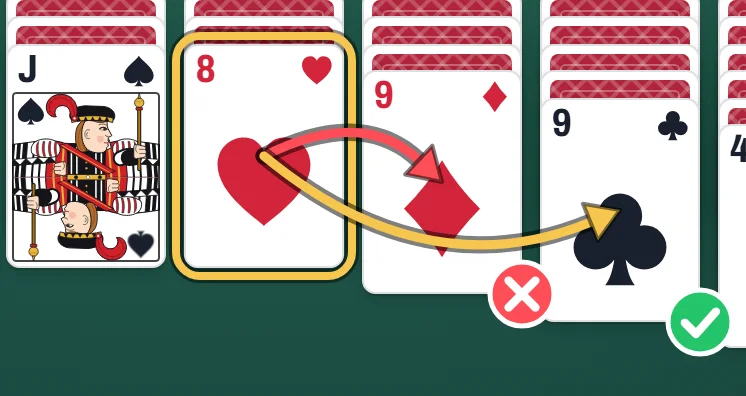
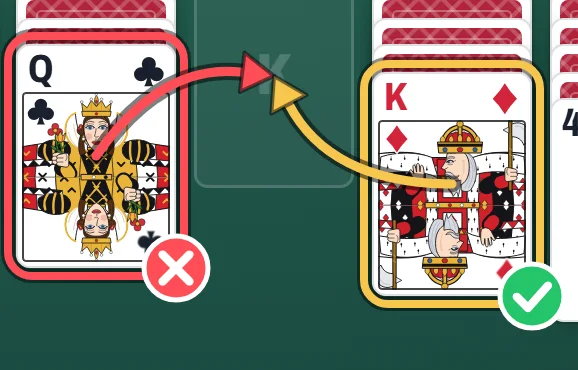
Two more moves the rules don't allow: putting a card on a foundation of another suit (the 2 of hearts only goes on the Ace of hearts), and in Draw 3, playing one of the cards under the top card of the waste.
How you win
The game is won when all 52 cards are on the foundations, four piles from Ace to King. Once the stock and waste are empty and every card in the columns is face up, nothing can go wrong: tap Finish and the cards go up by themselves. If you run out of useful moves, the game tells you, and you can undo some moves or deal again.
Draw 1 or Draw 3
Both modes deal the same table and follow the same rules. Only the stock works differently.
- Draw 1: each tap turns over one card, so you can reach every card in the stock on every pass. Turning the waste back over costs 100 points.
- Draw 3: each tap turns over three cards and only the top one can be played. The cards under it become playable as the cards above them are used. Turning the waste back over costs nothing.
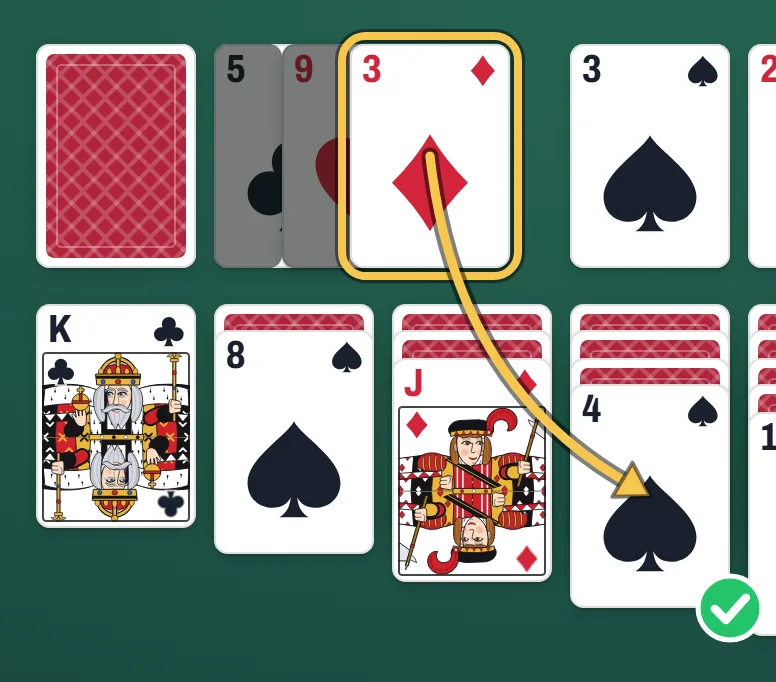
Because cards stay stuck behind others, Draw 3 is the harder game, and the traditional one. Draw 1 is the better place to learn. To switch, tap New and pick a mode.
Controls
- Drag a card or a run onto a column or foundation. The places it can go light up while you drag.
- Tap or click a card to send it to the best place: a foundation if it fits there, otherwise a column.
- Hint shows a useful move. Press it again to see another one.
- Undo takes back as many moves as you like.
- When the stock and waste are empty and every card is face up, the Finish button plays the rest for you.
- On a keyboard, Space turns over stock cards, H shows a hint, Ctrl + Z undoes a move and N starts a new game.
Scoring
| Move | Points |
|---|---|
| Waste card to a column | +5 |
| Waste card to a foundation | +10 |
| Column card to a foundation | +10 |
| Turning over a face-down card | +5 |
| Foundation card back to a column | −15 |
| Turning the waste back over (Draw 1 only) | −100 |
Your score never goes below zero. Undo restores the score you had before the move.
Tips for winning more games
- Turn over face-down cards first. A move that reveals a hidden card is almost always the best move on the table.
- Start with the longest columns. The column on the right hides six cards. Uncovering them early gives you the most choices later.
- Don't empty a column without a King ready. Only a King can fill the space, so an empty column with no King to move in does nothing for you.
- Choose your King with care. If a red and a black King could both fill a space, pick the one whose Queen and Jack you can reach.
- Don't rush cards to the foundations. Aces and Twos can always go up, but a 5 or 6 left in a column can be a place to park other cards.
- Play the columns before the stock. The stock will still be there. A buried card in a column won't uncover itself.
- Use Undo to explore. Try a line of play, and if it goes nowhere, take it back. It costs nothing.
Questions
Can every game be won?
No. Some deals can't be solved however you play. Researchers at the University of St Andrews estimated that about 82% of Draw 3 deals could be won by a perfect player who could see every card. With face-down cards in the way, real win rates are lower, especially in Draw 3.
Which is harder, Draw 1 or Draw 3?
Draw 3. Turning three cards at a time leaves two of them out of reach until the top one is played, so many stock cards stay buried. In Draw 1 every stock card comes round on every pass, which is why it's the better game for learning.
Is this the same game as on the home page?
Yes. The Solitaire home page plays this same Klondike game. The two pages share your game in progress and your statistics, so you can move between them and carry on where you left off.
What happens if I close the page?
Your game is saved after every move. Open the page again in the same browser and you'll pick up where you left off.
Can I play offline?
Yes. After your first visit the game works without an internet connection. On a phone, add it to your home screen to open it like an app.
Why is it called Klondike?
Nobody knows for sure. The name is often linked to the Klondike Gold Rush of the late 1890s in Canada's Yukon, but there's no solid evidence for that. The earliest known rules are in the 1907 edition of Hoyle's Games, which calls it Seven-Card Klondike; by 1913 it was simply Klondike. It became hugely popular after a version shipped with Windows 3.0 in 1990. If you like it, try Yukon, a close cousin with no stock.