How to play Canasta
Canasta is a partnership rummy game from Uruguay, played with two decks and four jokers. You and your computer partner (North) play against West and East: build melds of the same rank, complete canastas of seven cards, and race to 5000 points. This page plays classic Canasta for four.
The goal
Score more than the other side, hand after hand, until one side reaches 5000 points. Points come from canastas, red threes, going out and the cards you meld; cards left in your hands count against you.
Setting up
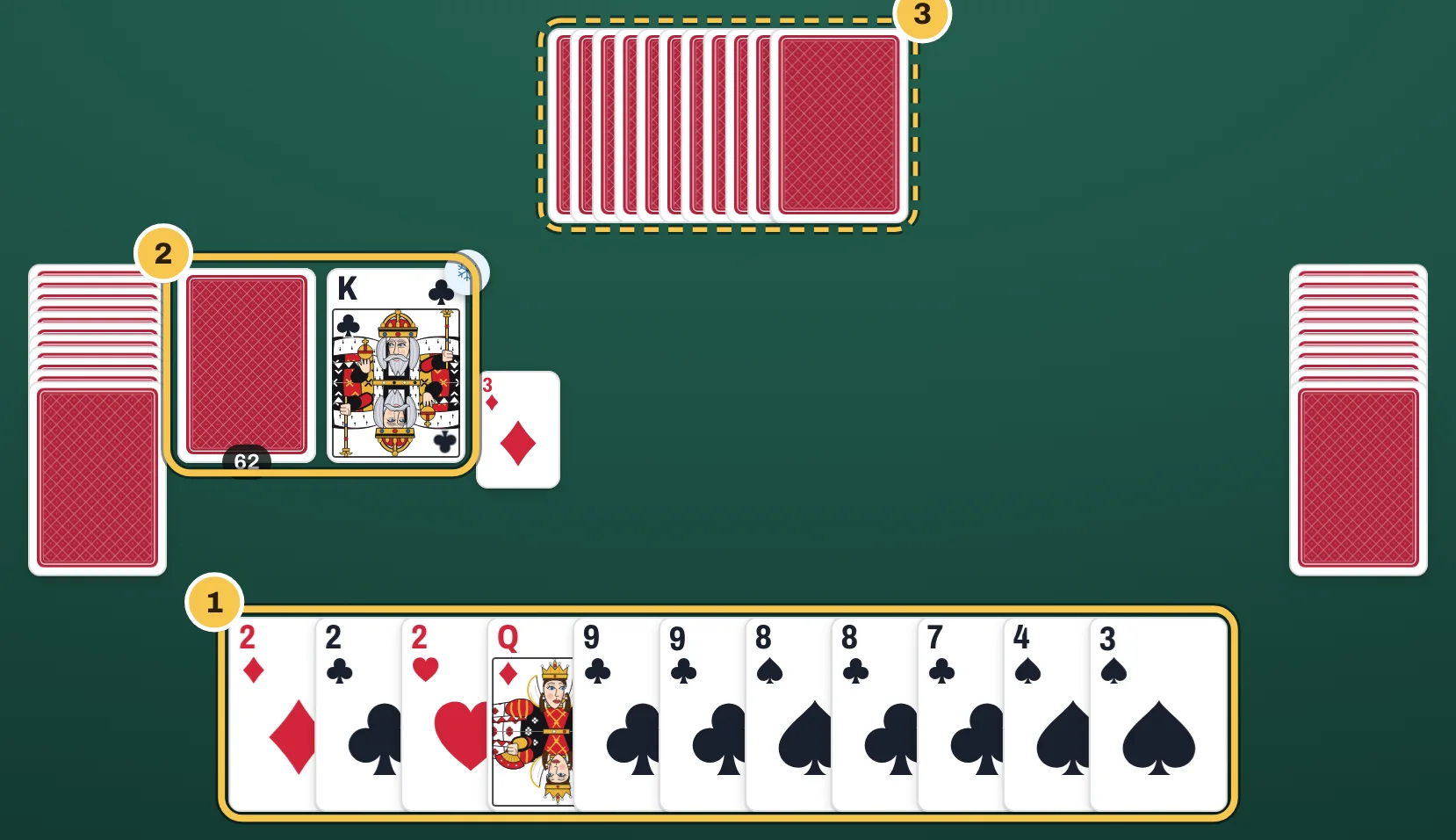
- 108 cards: two decks and four jokers. Everyone gets eleven cards; one card is turned up to start the discard pile.
- Wild cards: jokers and 2s can stand for any rank in a meld.
- Red threes are bonus cards: they go on the table at once, and you draw another card in their place.
- Black threes stop the next player from taking the discard pile.
How to play, step by step
- Draw. Tap the stock for its top card, or tap the discard pile to take the whole pile (see below).
- Meld. Choose three or more cards of one rank (wild cards may join) and tap Meld. Add more cards to your side's melds by choosing them and tapping the meld.
- Discard. Choose one card and tap Discard. Your turn ends.
- Build canastas. A meld of seven cards is a canasta. You need one before your side may go out.
- Go out by getting rid of your last card. The hand ends and both sides score.
Melds
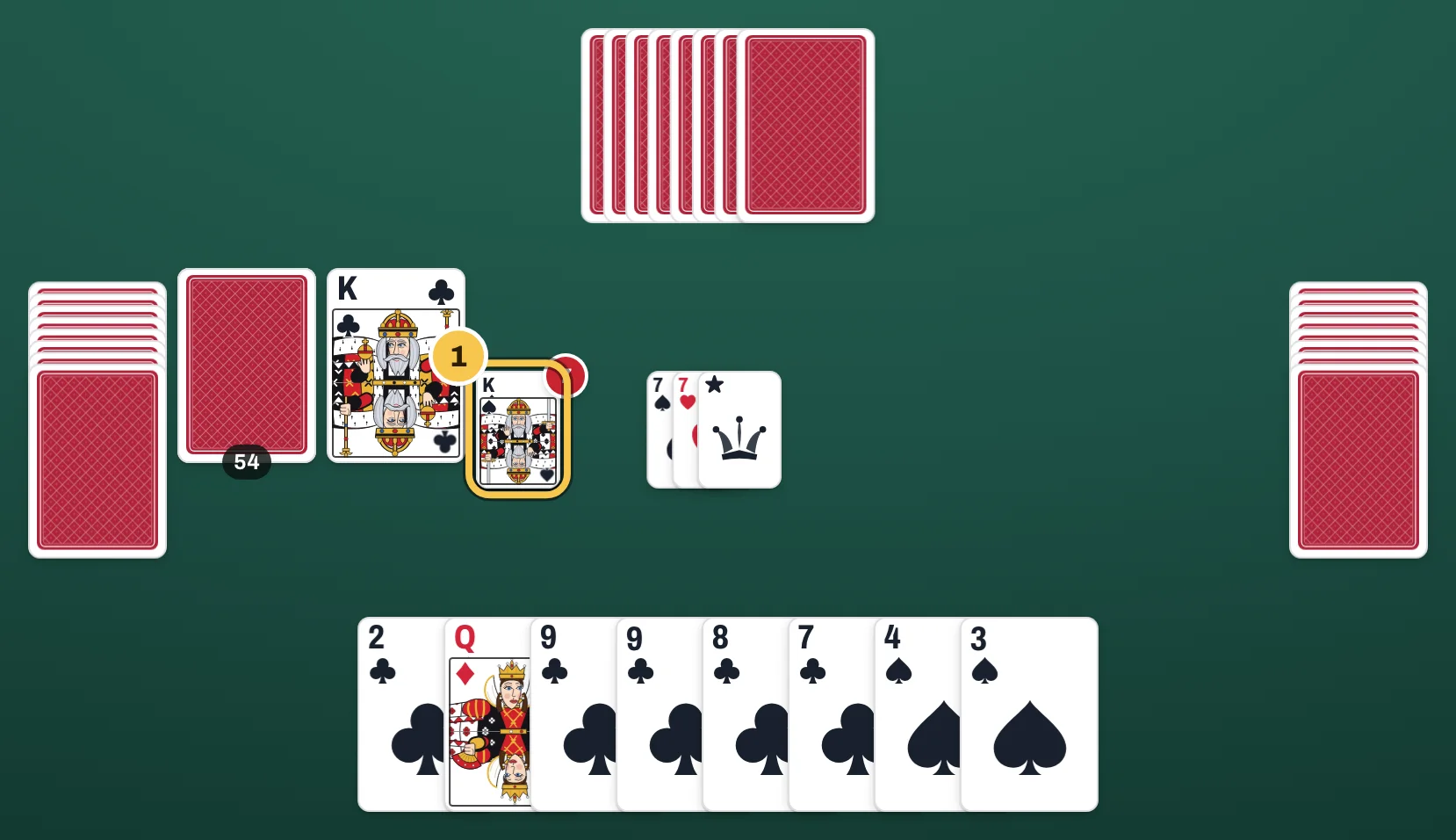
- A meld is three or more cards of the same rank: never a run of one suit.
- It needs at least two natural cards, and may hold at most three wild cards.
- Your side has one meld of each rank; more cards of that rank are added to it.
- The first meld of your side in a hand must count enough points: 50 normally, 15 when your score is below zero, 90 from 1500 points and 120 from 3000.
Taking the discard pile
The whole pile is worth taking. To take it, you must meld its top card at once: with a natural pair of the same rank from your hand, or, when the pile isn't frozen, with one natural card and a wild card, or by adding it to a meld of your side. The rest of the pile goes into your hand.
The pile is frozen (a snowflake shows it) while it holds a wild card, and for a side that hasn't melded yet. Then only a natural pair can take it. A wild card or a black three on top can't be taken at all.
Common mistakes
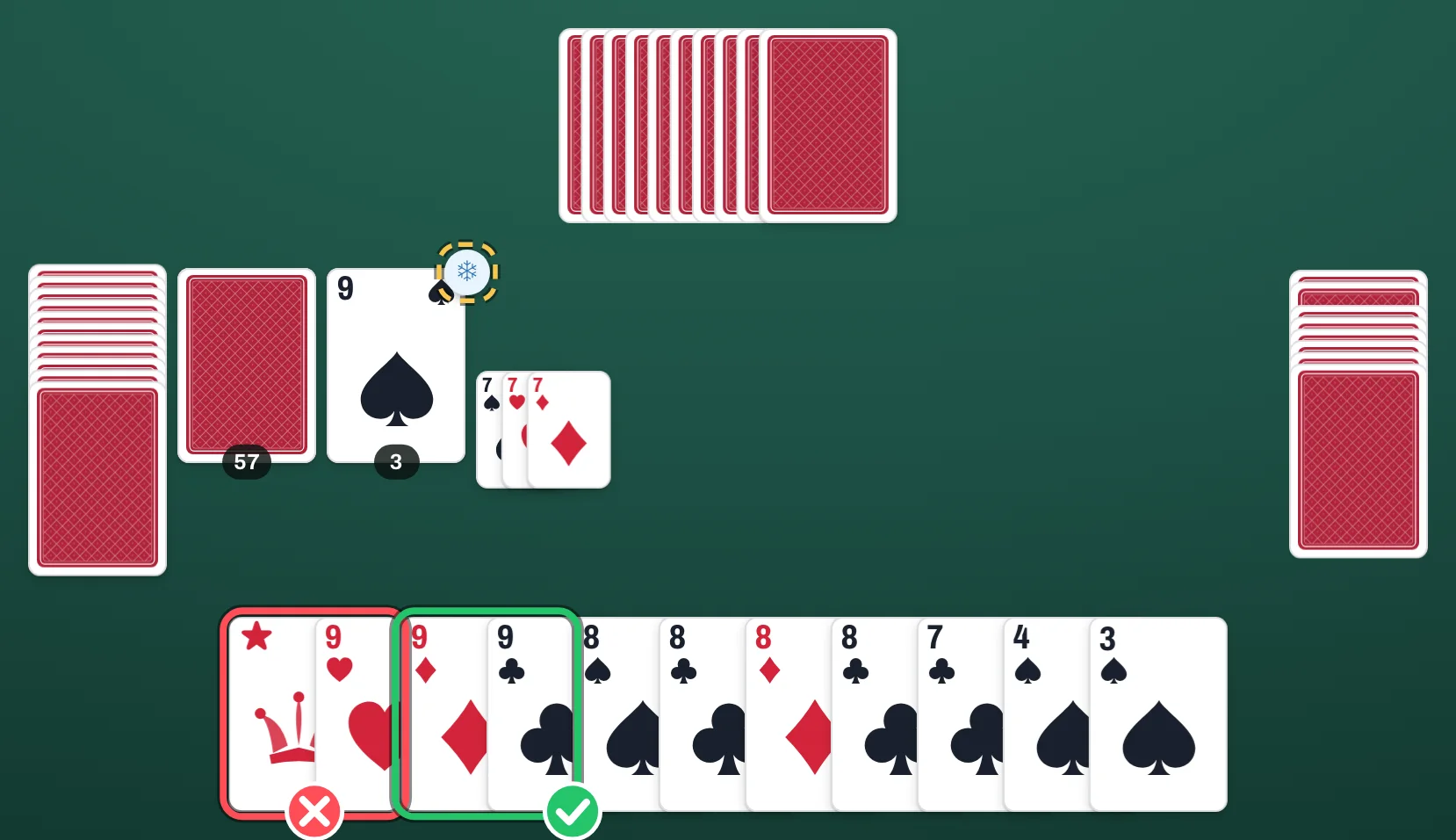
Two more things catch new players. Discarding a card your opponents have melded lets them take the pile by adding it to their meld. And melding everything at once: without a canasta your side can't go out, so you must keep cards in hand.
Scoring
| What | Points |
|---|---|
| Natural canasta (no wild cards) | 500 |
| Mixed canasta | 300 |
| Each red three (all four: 800) | 100 |
| Going out | 100 |
| Going out in the turn of your side's first meld | 200 |
| Joker | 50 |
| 2 or Ace | 20 |
| King to 8 | 10 |
| 7 to 4, black 3 | 5 |
Each card melded counts for your side; each card left in your side's hands counts against it. Red threes count against a side that hasn't melded anything in the hand.
How you win
The first side to reach 5000 points (2500 in the shorter game) at the end of a hand wins; if both do, the higher score wins. Choose the length under New.
The rules this page plays
Classic four-player Canasta as it is usually written down: one card drawn from the stock, one meld of each rank per side, black threes melded only when going out, and no asking your partner before going out. When the stock runs out, play goes on while players take the discard pile; the hand ends when someone can't or won't.
Controls
- Tap the stock to draw, or tap the discard pile to take it. With cards chosen first, they are the ones melded with its top card.
- Tap cards in your hand to choose them, then Meld or Discard; tap one of your side's melds to add the chosen cards to it.
- Hint shows what the computer would do in your place.
- There is no Undo: the other players have seen your cards.
Tips for winning more games
- Go for the pile. A big discard pile wins hands; keep pairs that could take it.
- Freeze the pile with a wild card when your opponents are about to take it.
- Watch their melds. Don't discard ranks your opponents have melded while the pile is open.
- Black threes are safe discards. The next player can't take the pile over them.
- Save wild cards to finish canastas; natural canastas are worth more.
- Go out when you're ahead, and wait when the other side holds many cards.
Questions
Where does Canasta come from?
It was invented in Montevideo, Uruguay, in 1939, spread through South America in the 1940s and reached the United States in 1949. Its name is Spanish for "basket".
Why can't I take the discard pile?
Either the pile is frozen and you don't hold a natural pair of its top card's rank, your side's first meld wouldn't reach the minimum, or a wild card or black three is on top. The message says which.
What is a frozen pile?
A pile that holds a wild card, or that your side hasn't been able to open with a first meld yet. Only a natural pair of its top card's rank can take it.
Is it free? Do I need an account?
Yes, it's free, and you don't need an account or a download. Your current game and your statistics are saved in this browser on this device. A free account is optional: it keeps your games on every device and puts your wins on the leaderboards.
What happens if I close the page?
Your game is saved after every move. Open the page again in the same browser and you carry on where you were.
Can I play offline?
Yes. After your first visit, the game works without an internet connection. On a phone, add it to your home screen to open it like an app.