How to play Cribbage
Cribbage is a card game for two in which you score for combinations of cards: cards that add up to 15, pairs, runs and flushes. You play against North, the computer. Every point is counted for you and marked on the score board.
The goal
Be the first to reach 121 points (or 61 in the short game). Points come three ways: during the play of the cards, when you count your hand in the show, and from the crib when it is yours.
Setting up
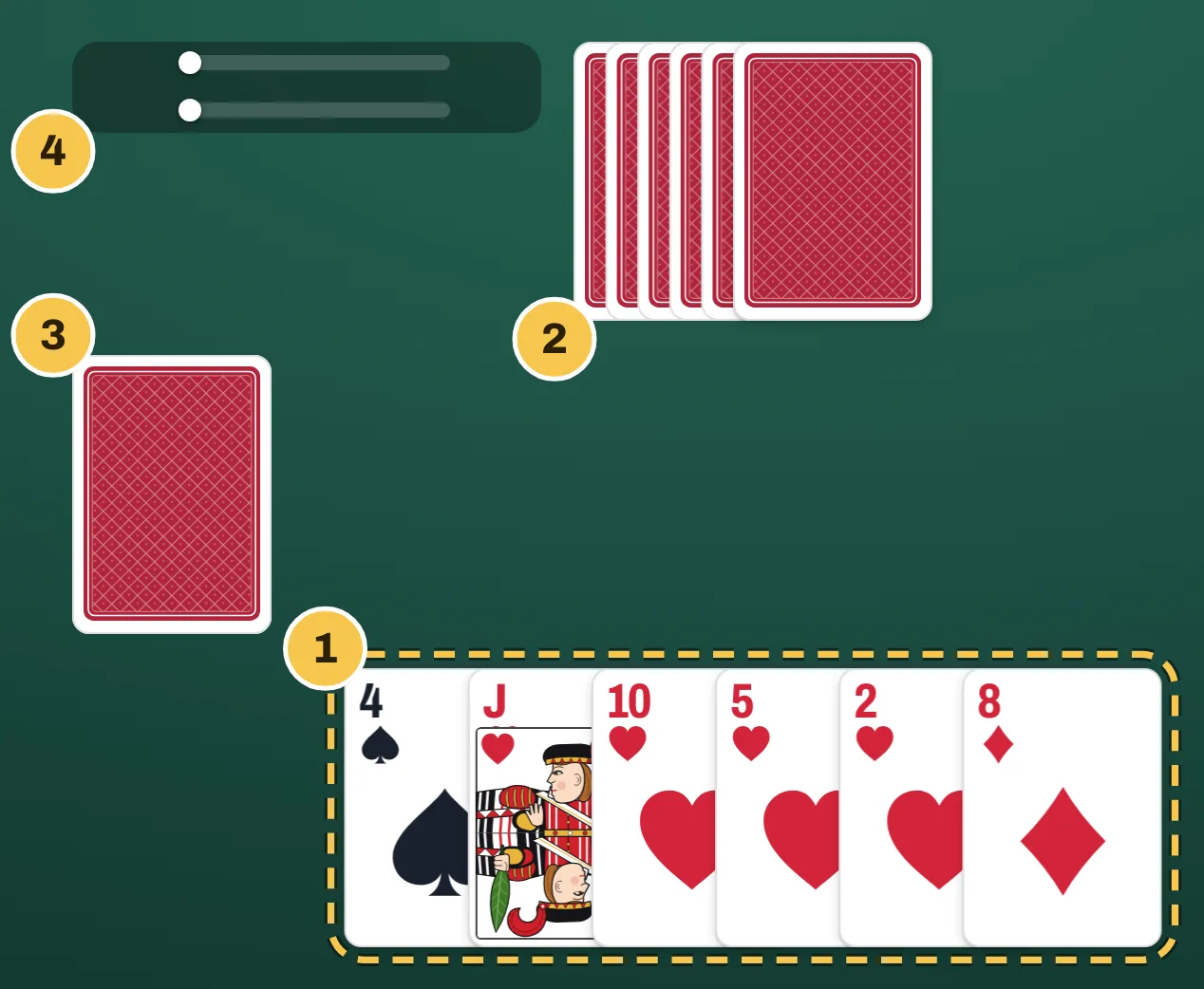
- Two players, one deck. Each player gets six cards. North deals the first hand, then the deal alternates.
- The crib. Each player lays two cards away, face down. These four cards are the crib: an extra hand that belongs to the dealer and is counted for them at the end of the hand.
- The starter. Then the top card of the deck is turned up. It counts with both hands and the crib in the show. If it is a Jack, the dealer scores 2 at once ("his heels").
- Card values. In the count an Ace is 1, the 2 to 10 are worth their number, and the Jack, Queen and King are worth 10. In runs the cards go in their usual order, Ace (always low), 2, 3 … 10, Jack, Queen, King.
How to play, step by step
- Lay away. Choose the two cards for the crib. Keep the four that score best together.
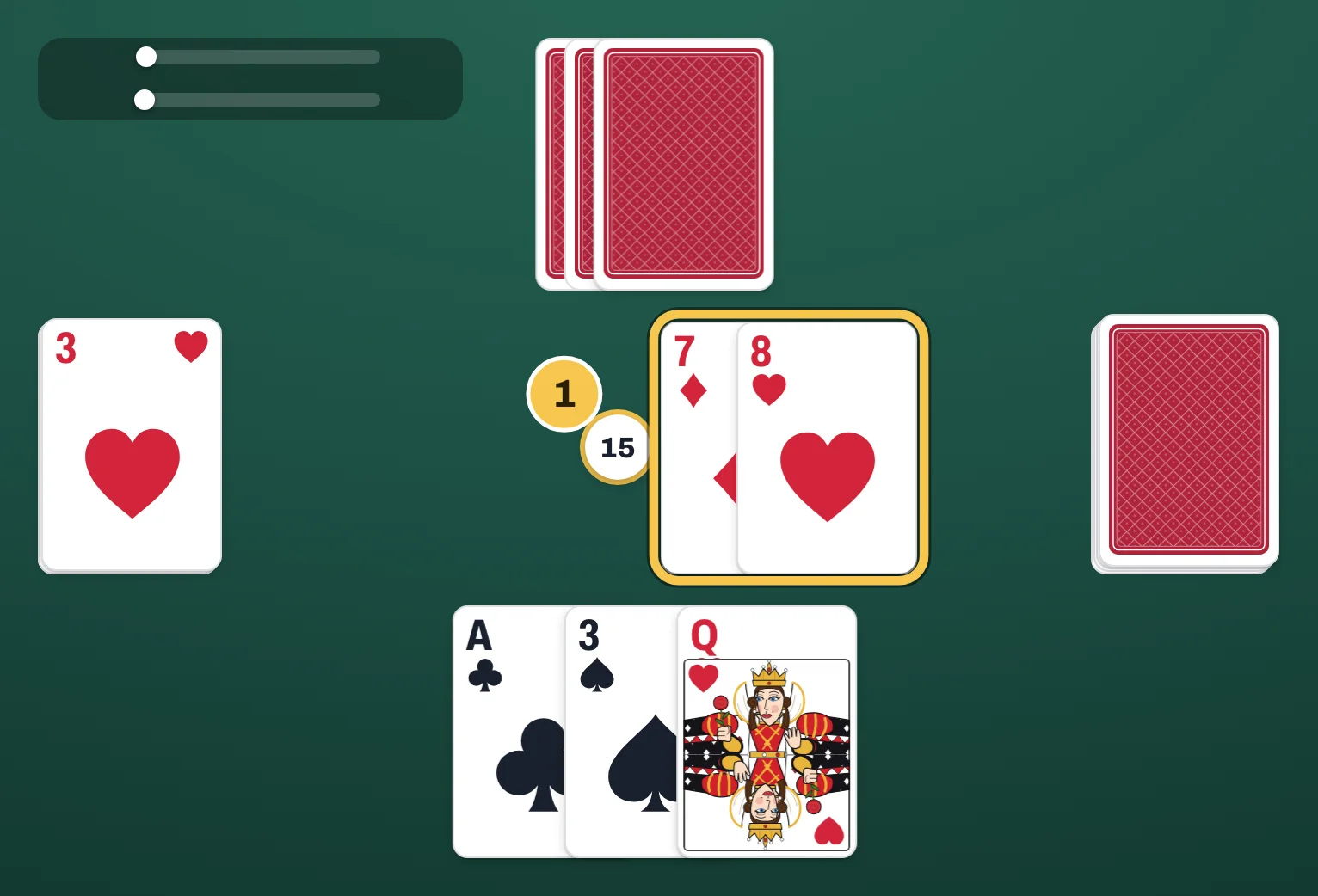
- The play. The dealer's opponent lays a card face up and calls its value. Then the players take turns, each laying a card and calling the new total. The count may never go past 31.
- Score in the play. Make the count exactly 15 or 31: 2 points. Lay a card of the same rank as the one just laid: a pair, 2 points (three of a kind 6, four 12). Make a run of three or more cards in a row with the cards just laid, in any order: a point for each card.
- Go. If you can't lay a card without passing 31, you say "go", and the other player lays any cards they can. The last to lay a card scores 1 (2 for exactly 31), and the count starts again from 0. The last card of the hand scores 1 too.
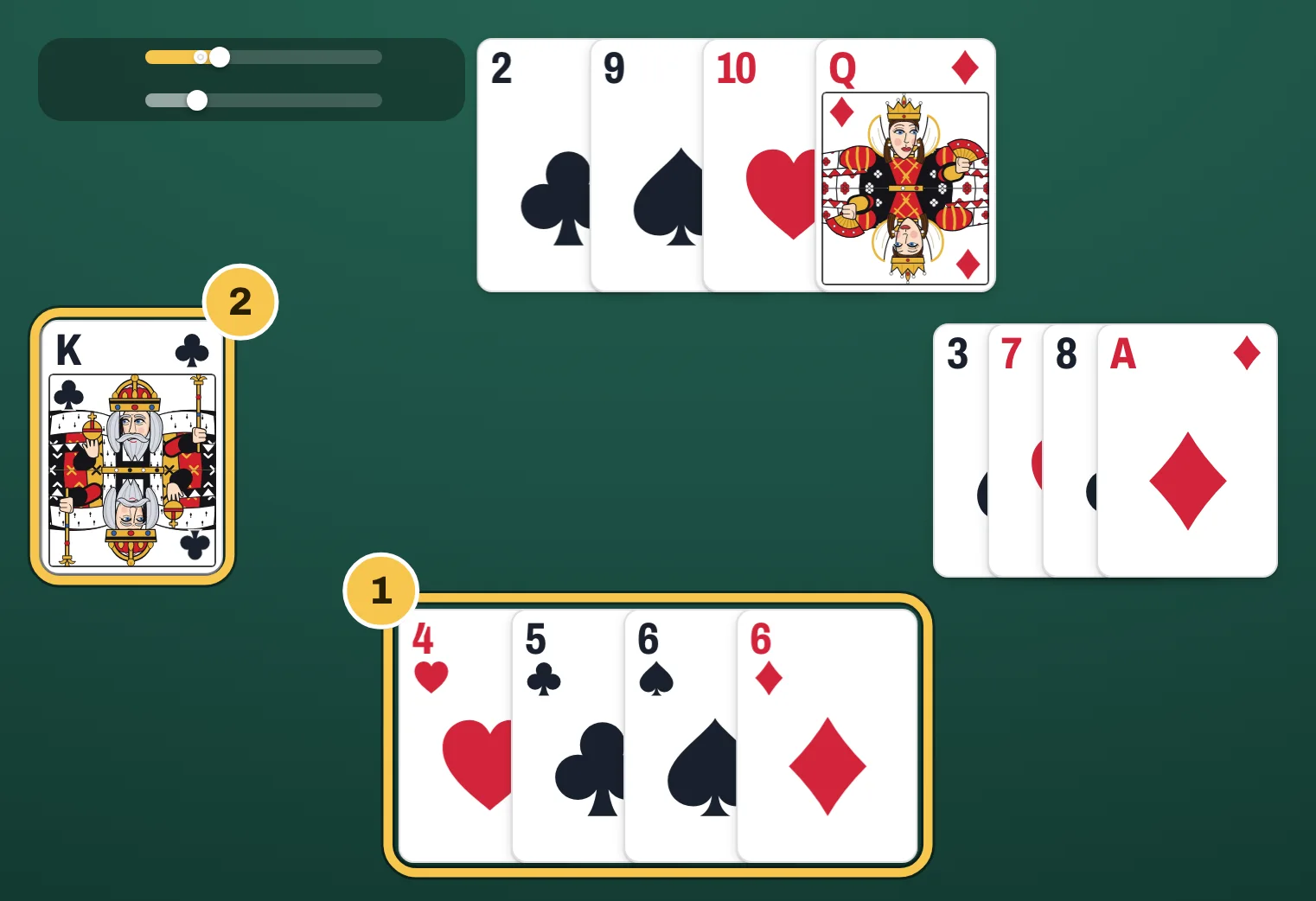
- The show. The dealer's opponent counts their hand first, then the dealer counts their hand and then the crib. Each counts its four cards together with the starter. More on this: How to count a Cribbage hand without missing points.
- What counts in the show. Every combination of cards that adds up to 15, every pair and every run of three or more, a flush, and the Jack of the starter's suit ("his nobs"). The scores are in the table below.
Common mistakes
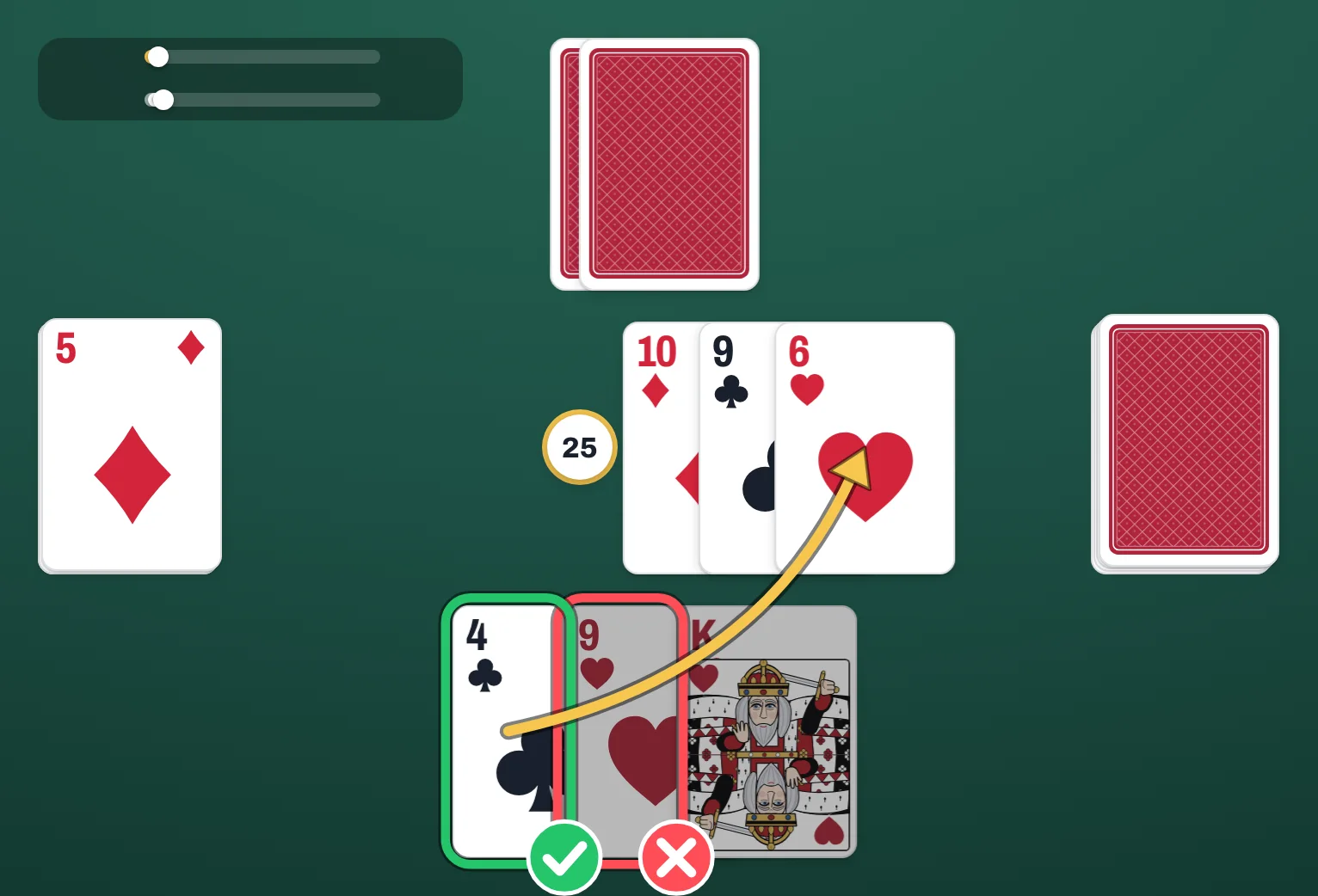
Two more things catch new players. In the play, a pair or a run counts only with the cards just laid: a card in between breaks it. And in the show every combination counts on its own, so two 6s with a 4 and a 5 make two runs and two fifteens. Cards you can't lay now are shown darker.
Scoring
| What happened | Points |
|---|---|
| In the play: the count is exactly 15, or exactly 31 | 2 |
| In the play: a pair, three of a kind, four of a kind | 2, 6, 12 |
| In the play: a run of three or more cards | 1 for each card |
| In the play: the last card before the count starts again, or the last card of the hand | 1 |
| In the show: each combination of cards that adds up to 15 | 2 |
| In the show: each pair | 2 |
| In the show: each run of three or more cards | 1 for each card |
| In the show: four cards of one suit in the hand (five with the starter) | 4 (5) |
| In the show: all five cards of one suit in the crib | 5 |
| His nobs: the Jack of the starter's suit in a hand or the crib | 1 |
| His heels: a Jack turned up as the starter (for the dealer) | 2 |
After the show a panel lists what each hand and the crib counted. The board keeps two pegs for each player: the front one at the score, the back one where it was before the last points.
How you win
The first player to reach the target wins at once, even in the middle of the play or the show. Since the dealer's opponent counts first in the show, near the end that player often gets home first. Choose the target under New: 121 points for the full game, 61 for a shorter one.
The rules used here
This is six-card Cribbage for two, the standard game described by Hoyle and Bicycle. The points are counted for both players, so nobody loses points they forgot to claim, and a game is simply won or lost (no extra score for winning by a wide margin). North deals the first hand; in a game at a table, the players would cut the deck to decide.
Controls
- Tap two cards to choose them for the crib (tap one again to put it back), then press Lay away 2 cards.
- Tap a card to lay it in the play. Cards that would take the count past 31 are shown darker.
- When you can't lay a card, the game says go for you.
- The number beside the cards in the middle is the count. The board shows both scores.
- Hint suggests two cards for the crib, or the card to lay.
- There is no Undo: once a card is laid, North has seen it.
- On a keyboard, H shows a hint and N opens the new game options.
Tips for winning more games
- Keep 5s. A 5 makes 15 with every 10, Jack, Queen and King, the most common value in the deck.
- Keep cards that work together. Pairs and cards in sequence, such as 6-7-8, score in runs and in fifteens.
- Think of whose crib it is. Lay a 5 or a pair into your own crib; give North's crib cards that are far apart, such as a King and a 2.
- Lead a low card. A card under 5 can't be answered with a 15.
- Avoid counts of 5 and 21. One of the many 10-cards turns them into 15 or 31 for your opponent.
- Hold a low card back. Late in a count, a small card lets you play on and take the go.
Questions
Why do both players lay cards into the crib?
The crib is the dealer's extra hand, made from both players' discards. As the deal alternates, each player gets the crib every other hand, so you have to judge your discards both ways: good cards for your own crib, poor ones for North's.
What does go mean?
You can't lay a card without taking the count past 31. The other player then lays any cards they can, takes 1 point for the last card (2 if the count is exactly 31), and a new count begins from 0.
How does the computer play?
It follows the same rules and sees only its own cards and the cards laid. It keeps the four cards that score best on average over every possible starter, weighing whose crib it is, and in the play takes points where it can while avoiding counts that give you an easy 15 or 31.
Is it free? Do I need an account?
Yes, it's free, and you don't need an account or a download. Your current game and your statistics are saved in this browser on this device. A free account is optional: it keeps your games on every device and puts your wins on the leaderboards.
What happens if I close the page?
Your game is saved after every card you play. Open the page again in the same browser and you carry on where you were.
Can I play offline?
Yes. After your first visit, the game works without an internet connection. On a phone, add it to your home screen to open it like an app.