How to play the Sliding Puzzle
The Sliding Puzzle, best known as the 15 Puzzle, is a frame of numbered tiles with one empty cell. Slide the tiles one by one until they stand in order. It became a craze in 1880 and has been a favorite ever since.
The goal
Put the tiles in order: 1 at the top left, then row by row, with the empty cell at the bottom right.
Setting up
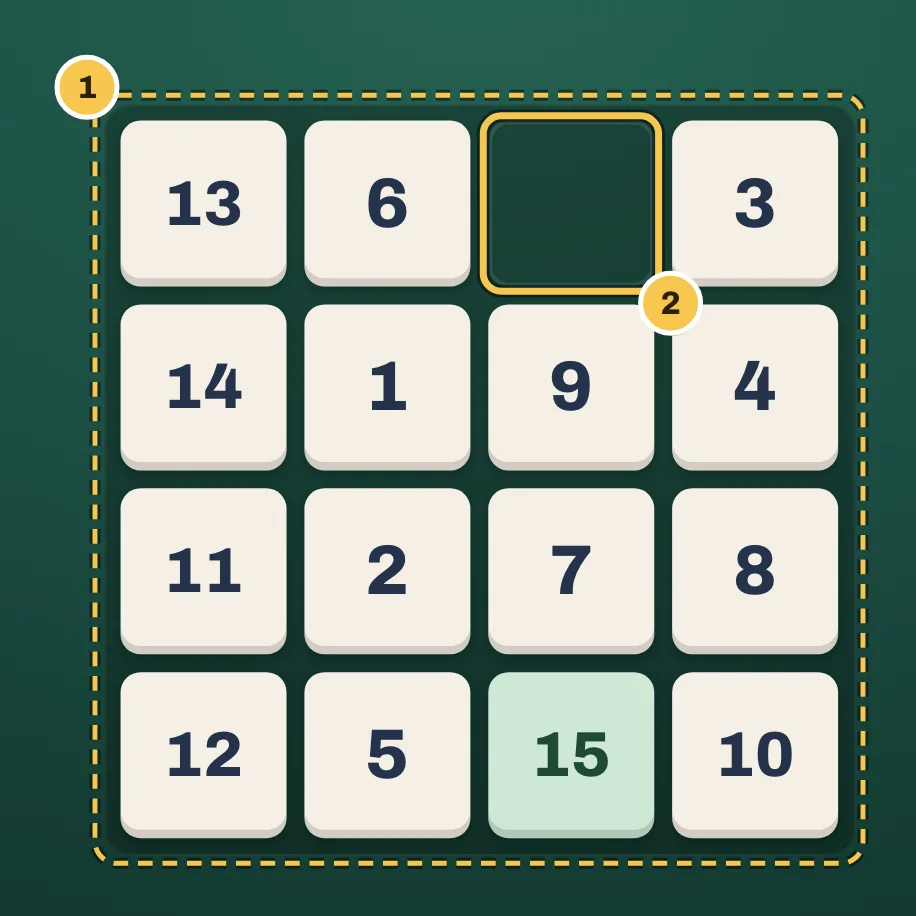
- The board. 4 by 4 cells for the 15 Puzzle, 3 by 3 for the small one, 5 by 5 for the large one.
- The tiles. Numbered from 1, one fewer than the cells, so one cell is always empty.
- Every puzzle can be solved. Half of all ways to shuffle the tiles can never be put in order; the game only deals the other half.
How to play, step by step
- Find the empty cell. Only tiles in its row or its column can move.
- Slide a tile. Tap a tile next to the empty cell: it slides into it.
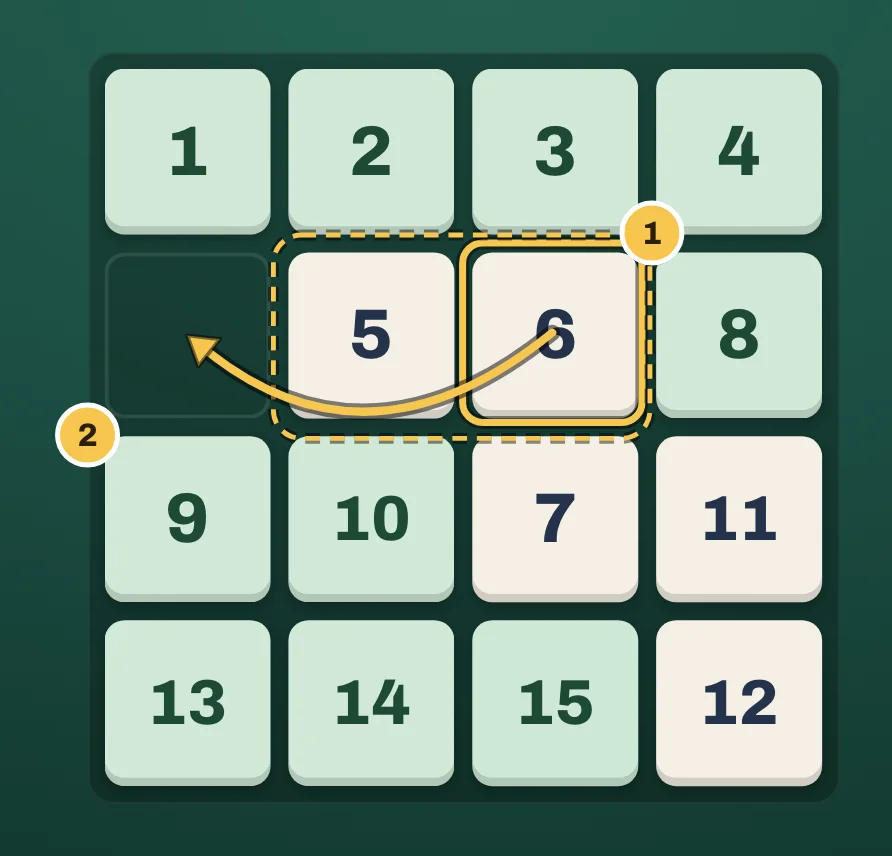
- Slide several at once. Tap a tile further along the same row or column: it and every tile between it and the empty cell slide one step together.
- Watch the colors. A tile in its right place turns green.
- Win. When every tile is in order, the puzzle is solved.
Common mistakes
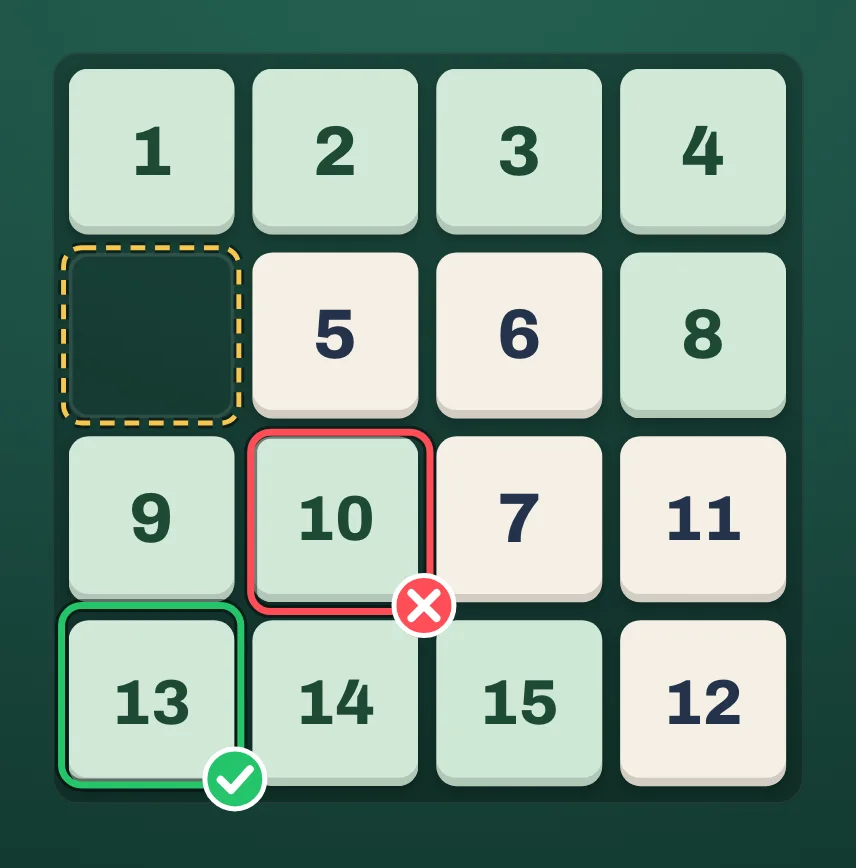
Two more things catch new players. Placing tiles one by one in any order soon means moving finished tiles out again: build the top row first, then the left column, and only then the rest. And the last two tiles of a row never go in one at a time. Put them in together: bring the last one under the corner first, then turn both into place.
Sizes
| Size | Tiles | Fewest moves that solve any puzzle |
|---|---|---|
| Small 3×3 | 8 | 31 |
| Classic 4×4 | 15 | 80 |
| Large 5×5 | 24 | Not known |
There are no points: the top bar counts your moves (one for every tile that slides) and the tiles already in place, and the statistics keep your best time and fewest moves for each size.
How you win
Put every tile in order with the empty cell last. Choose the size under New.
Undo and hints
Undo takes back as many moves as you like. Hint marks the next tile to slide on a way that always finishes: the top row first, then the left column, then the smaller square left over. Follow the hints and the puzzle is solved, though not in the fewest moves.
Controls
- Tap a tile in the empty cell's row or column to slide it.
- Swipe across the board: the tile beside the empty cell slides that way.
- On a keyboard, the ← ↑ → ↓ arrow keys slide a tile into the empty cell, U takes back a move, H shows a hint and N opens the new puzzle options.
Tips for solving faster
- Top row first. Place 1, 2 and 3 (on the 4×4 board), then the last tile of the row.
- Then the left column. After the top row, place the tiles down the left side the same way.
- Leave finished tiles alone. Work in the part of the board that isn't done yet.
- Pair the last two. Line up the last two tiles of a row or column side by side, then slide them in together.
- Move the empty cell, not the tile. Think of where the empty cell has to go to push your tile one step.
- Finish with a circle. The last small square is solved by turning its tiles round and round until they fall in order.
Questions
Can every puzzle be solved?
Every puzzle dealt here can. In 1879 two mathematicians, Johnson and Story, proved that half of all ways to arrange the tiles can never be put in order, such as the board in order with only 14 and 15 swapped. The game checks each shuffle and deals only the solvable half.
How many moves does it take?
Any small 3×3 puzzle can be solved in 31 moves or fewer, and any 4×4 puzzle in 80 or fewer, counting each tile that slides. Finding those shortest ways is hard even for computers; a good solve by hand takes more.
Does Undo cost anything?
No. Undo as often as you like; the move counter simply goes back with it.
Is it free? Do I need an account?
Yes, it's free, and you don't need an account or a download. Your current game and your statistics are saved in this browser on this device. A free account is optional: it keeps your games on every device and puts your wins on the leaderboards.
What happens if I close the page?
Your puzzle is saved after every move. Open the page again in the same browser and you carry on where you were.
Can I play offline?
Yes. After your first visit, the game works without an internet connection. On a phone, add it to your home screen to open it like an app.