How to play Killer Sudoku
Killer Sudoku is Sudoku with a twist of arithmetic. No digits are given. Instead, the grid is divided into cages, each with a small sum in its corner, and the digits in a cage must add up to that sum. Every puzzle here has exactly one solution.
The goal
Fill every cell with a digit from 1 to 9 so that every row, every column and every box of nine cells holds each digit once, and the digits in every cage add up to its sum, with no digit twice in a cage.
The grid
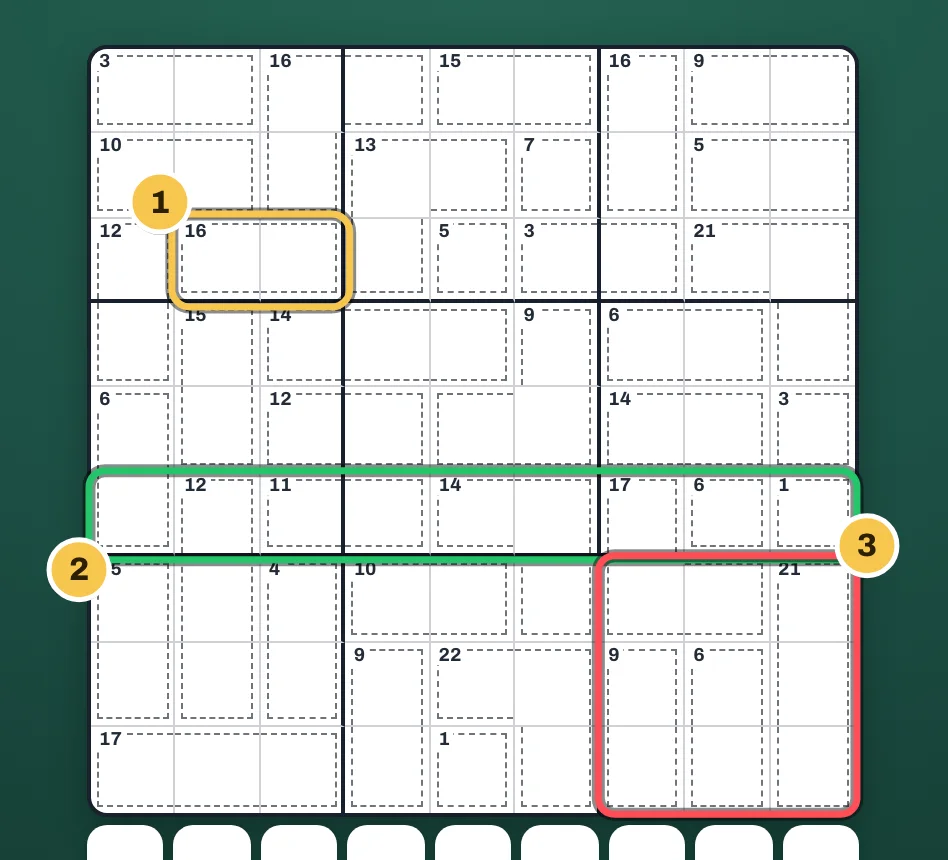
- 81 cells in nine rows, nine columns and nine boxes of three by three, as in Sudoku.
- Cages. Dashed outlines group the cells into cages, most of them two to four cells. The small number is the cage's sum.
- No digit twice in a cage. A cage of two cells with the sum 4 is 1 and 3, never 2 and 2.
- Your digits are blue. A digit that doesn't belong in its cell turns red, and it is counted as a mistake.
How to play, step by step
- Choose a cell. Tap it. Its row, column, box and cage are tinted.
- Enter a digit. Tap one of the digits under the grid. Tap the same digit again, or Erase, to take it away.
- Start with the sums that allow one set of digits. 3 in two cells can only be 1 and 2; 17 in two cells only 8 and 9.
- Use what's left of a sum. A cage of two cells with the sum 10 and a 4 in it needs a 6 in the other cell.
- Use the Sudoku rules too. A digit already in a row, column or box can't go anywhere else in it.
- Carry on until the grid is full.
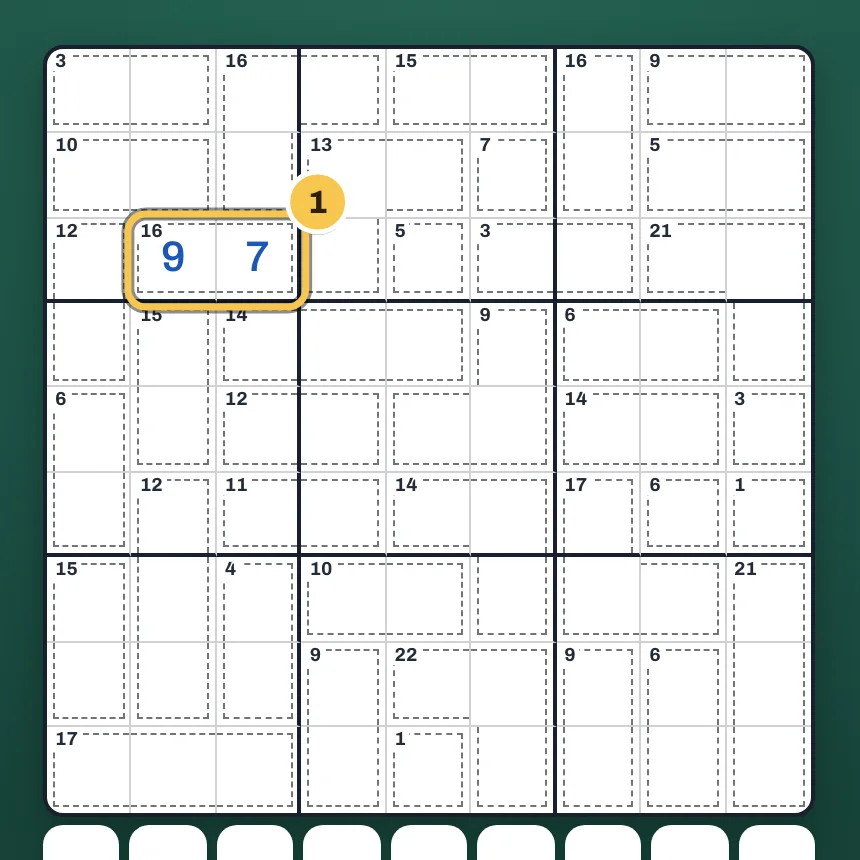
Sums with only one set of digits
| Cells | Small sums | Large sums |
|---|---|---|
| 2 | 3 = 1+2, 4 = 1+3 | 16 = 7+9, 17 = 8+9 |
| 3 | 6 = 1+2+3, 7 = 1+2+4 | 23 = 6+8+9, 24 = 7+8+9 |
| 4 | 10 = 1+2+3+4, 11 = 1+2+3+5 | 29 = 5+7+8+9, 30 = 6+7+8+9 |
The rule of 45
The digits 1 to 9 add up to 45, so every row, column and box sums to 45. When the cages inside a box cover all its cells but one, that cell is 45 minus their sums. The same works for a row or a column, and for a cage that sticks out of a box by one cell.
Pencil marks
When a cell could still hold several digits, write them down small. Tap Notes, choose a cell, and tap the digits that are still possible there. When you place a digit, its pencil marks in the same row, column, box and cage are removed for you.
Common mistakes
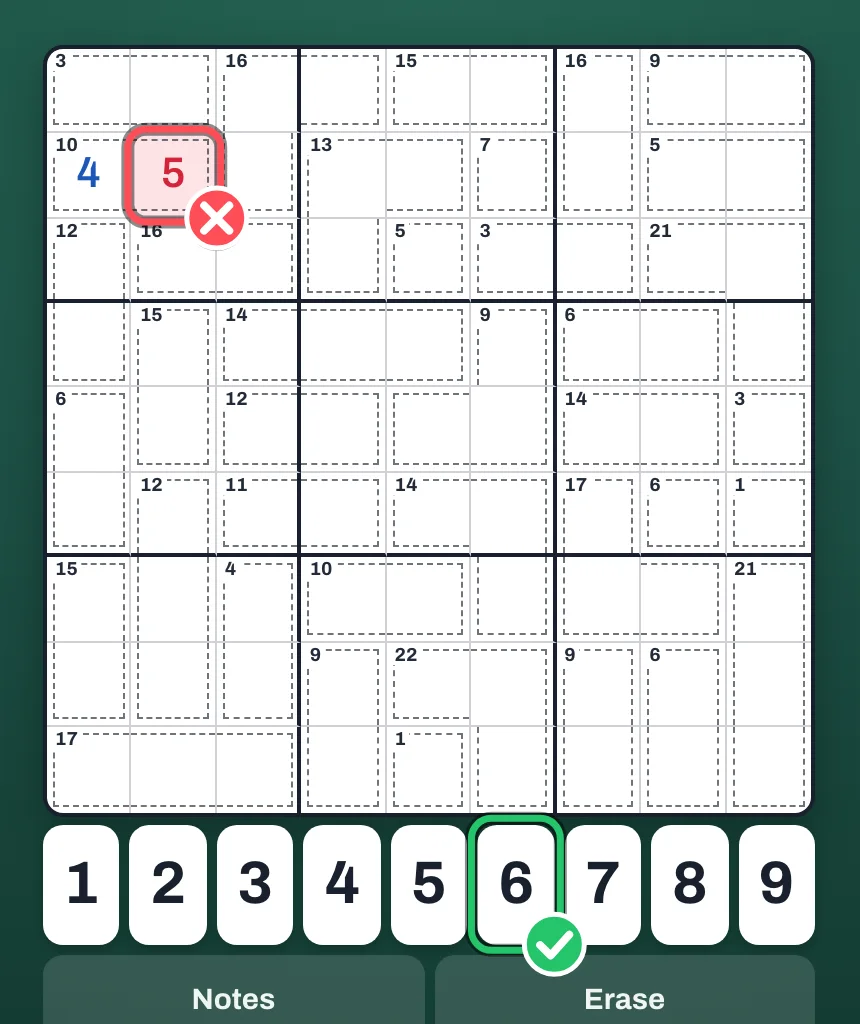
Two more things catch new players. Repeating a digit in a cage: a cage of two cells with the sum 8 is never 4 and 4. And forgetting the Sudoku rules while adding: a sum may fit, but the digit can still be blocked by its row, column or box.
How you win
The puzzle is solved when all 81 cells hold their digit. Your time and your mistakes are shown, and your best times are kept for each level. Choose the level under New.
The three levels
- Easy has small cages, a few of them single cells that give their digit away. Every step follows from a sum or the Sudoku rules, so you never need to guess.
- Medium has cages of two to five cells and at most two single cells.
- Hard has bigger cages and no single cells: you will need the rule of 45 and pencil marks.
Controls
- Tap or click a cell, then a digit. Cells with the same digit as the chosen cell are tinted blue.
- Notes switches pencil marks on and off. Erase empties the chosen cell.
- Hint chooses a cell you can fill now and tells you why. If a digit is wrong, it points to that one first.
- Undo takes back as many moves as you like.
- On a keyboard, the arrow keys move from cell to cell, 1 to 9 enter a digit, Backspace erases, M switches pencil marks, H shows a hint, U undoes a step and N opens the new puzzle options.
Tips for solving faster
- Learn the sums with one set of digits. The table above is the quickest start in every puzzle.
- Look for sums that rule digits out. 5 in two cells can't hold 5 or more; 15 in two cells holds neither 1 nor 5.
- Add up a box. Cages that fill a box but one cell give that cell away by the rule of 45.
- Mark pairs. If two cells of a row can hold only the same two digits, no other cell of the row can hold them.
- Fill the single cells first. A cage of one cell is simply its sum.
- Don't guess. Every puzzle has one solution that logic can reach.
Questions
Does every puzzle have exactly one solution?
Yes. Every puzzle was checked by a computer search: there is one way to fill the grid, and no other.
Why are there no digits to start with?
The sums of the cages take their place. Together with the Sudoku rules they decide every cell.
Do I need to be good at maths?
Only a little: adding small numbers. The table of sums with one set of digits and the rule of 45 do most of the work.
Is it free? Do I need an account?
Yes, it's free, and you don't need an account or a download. Your current game and your statistics are saved in this browser on this device. A free account is optional: it keeps your games on every device and puts your wins on the leaderboards.
What happens if I close the page?
Your game is saved after every move. Open the page again in the same browser and you'll pick up where you left off.
Can I play offline?
Yes. After your first visit, the game works without an internet connection. On a phone, add it to your home screen to open it like an app.