How to count a Cribbage hand without missing points
To count a Cribbage hand, take your four cards together with the starter and check them in the same order every time: fifteens, pairs, runs, a flush, and the Jack for his nobs. Each step looks at all five cards again, and a card can score in as many combinations as it fits. Count that way and you’ll stop leaving points behind.
Every hand below is scored exactly the way our Cribbage page scores it. That page uses the same order, so its panel after the show reads just like your count.
What you count, and in what order
You always count five cards: the four you kept plus the starter, which belongs to both hands and the crib. The dealer’s opponent counts first, then the dealer counts their hand, then the crib.
For fifteens, an Ace is 1, the 2 to 10 are worth their number, and the Jack, Queen and King are worth 10. For runs, the cards keep their usual order from Ace up to King, and the Ace is always low.
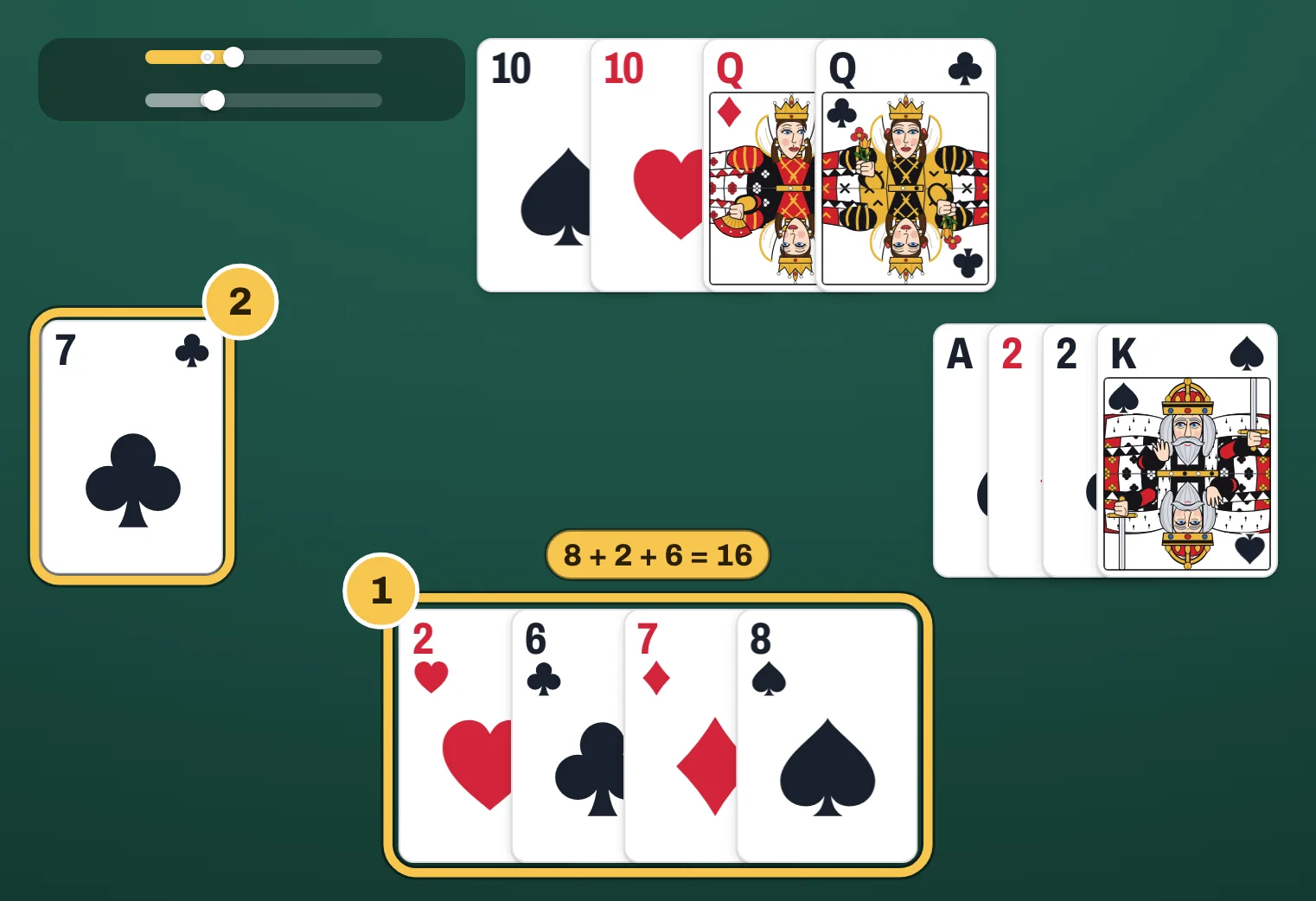
Here’s the hand we’ll count: 6♣ 7♦ 8♠ 2♥, with the 7♣ as starter.
Step 1: fifteens
Every different group of cards that adds up to exactly 15 scores 2 points. A group can be two, three, four or all five cards, and the same card can be in several groups.
Check them by size, so nothing slips through:
- Two cards. Only three kinds of pair make 15: a 5 with a 10-value card, a 6 with a 9, and a 7 with an 8.
- Three cards. Look for small cards that fill a gap: 2 + 6 + 7, or 3 + 2 + any 10-value card.
- Four cards, then all five. Rare, but they turn up in hands full of low cards, such as A-2-3-4-5.
Our hand: 7♦ + 8♠ = 15, fifteen two. 7♣ + 8♠ = 15, fifteen four. 2♥ + 6♣ + 7♦ = 15, fifteen six. 2♥ + 6♣ + 7♣ = 15, fifteen eight. That’s 8 points.
Notice the pattern: when a hand holds two cards of the same rank, every fifteen made with one of them has a twin made with the other. Find one, and look for its twin straight away.
Players count fifteens out loud in twos (“fifteen two, fifteen four…”) because it keeps the running total honest. Try it, even when you’re playing alone.
Step 2: pairs
Every two cards of the same rank make a pair worth 2. The suit doesn’t matter.
Three of a kind looks like one thing but holds three different pairs, so it scores 6. Four of a kind holds six pairs and scores 12.
Our hand has one pair, the 7♦ and 7♣: 2 points, for a running total of 10.
Step 3: runs
A run is three or more cards of consecutive rank, in any suits, worth 1 point per card. Two rules decide most arguments:
- Count only the longest run. 4-5-6-7 is one run of four, worth 4. It doesn’t also hold two runs of three.
- A repeated rank copies the run. Each copy of that rank makes its own run with the other cards.
Our hand has a 6, an 8 and two 7s, so it has two runs: 6♣-7♦-8♠ and 6♣-7♣-8♠. That’s 3 + 3 = 6, and the 2♥ plays no part. Running total: 16.
The Ace is always low. A-2-3 is a run, Q-K-A isn’t. Take A♠ 2♥ 3♦ K♣ with the Q♥ as starter: one run of three (3), plus K + 2 + 3 and Q + 2 + 3 (4), for 7 points. The Q-K-A at the top scores nothing.
Run shapes worth learning by sight
Some hands with repeated ranks come up again and again, and it’s quicker to know their value than to count each copy. The table counts runs and pairs only. Fifteens come on top.
| Shape | Example | Runs + pairs |
|---|---|---|
| Double run of three | 7-8-8-9 | 6 + 2 = 8 |
| Double run of four | 6-7-8-8-9 | 8 + 2 = 10 |
| Triple run | 7-8-8-8-9 | 9 + 6 = 15 |
| Double-double run | 7-7-8-8-9 | 12 + 4 = 16 |
A word on names. Many players say “a double run is 8” and mean the two runs and the pair together. Others score the runs (6) and the pair (2) separately. Both give the same total, as long as the pair is counted once. The two mistakes are counting it twice and forgetting it, which is why our panel shows pairs and runs on separate lines.
With their fifteens added, those shapes score more: 7♣ 8♦ 8♠ 9♥ with a K♣ starter makes 12, 6-7-8-8-9 makes 16, 7-8-8-8-9 makes 21, and 7-7-8-8-9 makes 24.
Step 4: a flush
If all four cards in your hand are the same suit, that’s a flush worth 4. If the starter matches too, it’s worth 5. Two cases trip people up:
- The crib needs all five. A crib scores a flush only when its four cards and the starter all share a suit, for 5. Four hearts in the crib with a club starter score nothing for the flush.
- The starter can’t finish a flush. Three hearts in your hand plus a heart starter is not a flush.
Example: 3♥ 6♥ 9♥ Q♥ with the J♣ as starter. The 6 + 9 make a fifteen (2) and the four hearts a flush (4): 6 points. The same four cards in the crib score only 2. Turn up the 2♥ instead and you get a second fifteen (2 + 3 + Q) and a five-card flush, for 9 points in the hand or the crib.
Step 5: his nobs
A Jack in your hand or the crib that matches the starter’s suit scores 1 point, called his nobs (“one for his nob”).
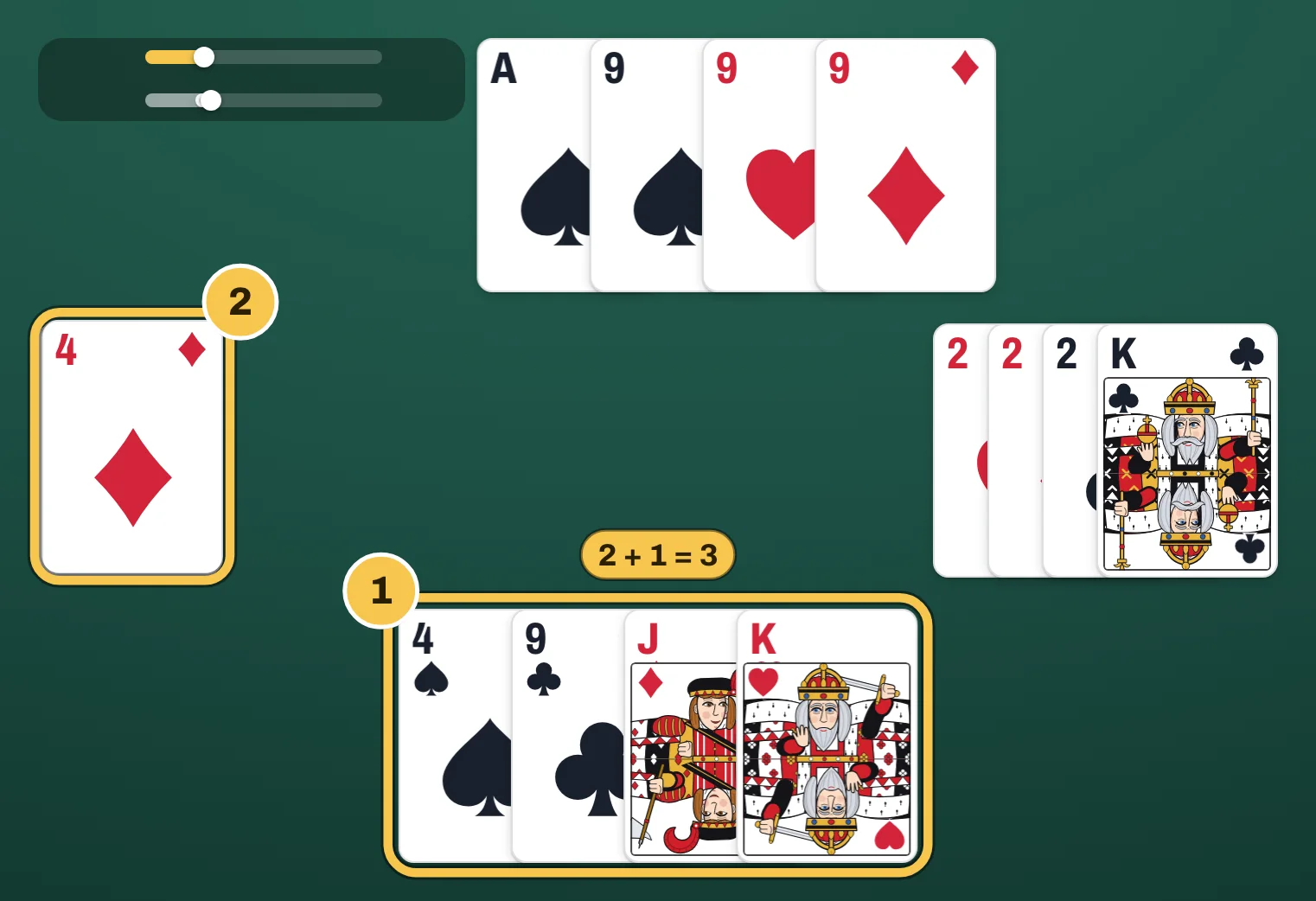
Don’t confuse it with his heels. When the starter itself is a Jack, the dealer pegs 2 straight away, as the card is turned up. It isn’t part of anyone’s count in the show.
Our hand, counted out loud
Back to 6♣ 7♦ 8♠ 2♥ with the 7♣: “Fifteen two, fifteen four, fifteen six, fifteen eight, a pair is ten, and two runs of three make sixteen.” No flush, no Jack. That’s 16 points, and on our Cribbage page the panel after the show lists fifteens 8, pairs 2 and runs 6.
Big hands, and one empty one
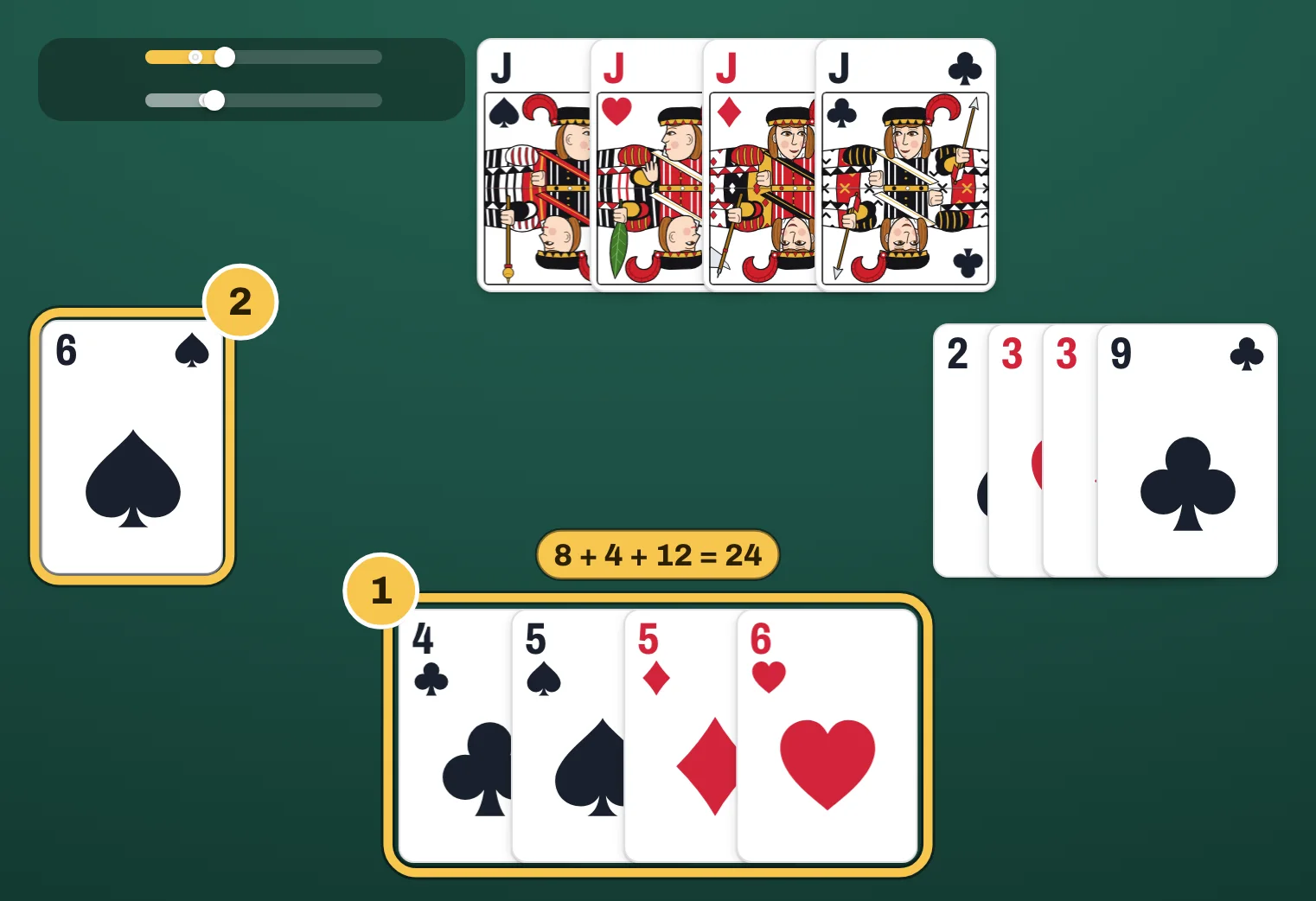
These four are worth knowing by heart.
- 4♣ 5♦ 5♠ 6♥, starter 6♠: 24 points. The two 5s and two 6s make four different 4-5-6 runs (12) and two pairs (4). Each of those 4-5-6 groups also adds up to 15, so there are four fifteens (8). It’s easy to score the runs and forget that every one of them is also a fifteen.
- 5♣ 5♦ 5♥ 5♠, starter K♥: 28 points. Each 5 makes 15 with the King (four fifteens), and each set of three 5s makes 15 on its own (four more): 16 for fifteens. Four of a kind adds 12.
- 5♣ 5♦ 5♥ J♠, starter 5♠: 29 points, the highest score in Cribbage. Fifteens and pairs as above make 28, and the J♠ matches the spade starter for his nobs. Only four combinations of hand and starter make it: three 5s and the Jack in the suit of the fourth 5, with that 5 turned up.
- 2♠ 4♥ 6♦ 8♣, starter Q♥: 0 points. No group of cards makes 15, no pairs, no run. It happens.
We had our game’s counting code score every possible four cards and starter. The highest total is 29, and four totals can never happen: 19, 25, 26 and 27. If you count one of those, count again.
Mistakes that cost points
- Using a card once and putting it aside. A card counts in every fifteen, pair and run it belongs to.
- Counting a run of three inside a run of four. Only the longest run counts.
- Forgetting that a run can also be a fifteen. 4-5-6 is both, and so is the 7-8 inside 6-7-8.
- Scoring a four-card flush in the crib. The crib needs all five cards in one suit.
- Adding the starter to a three-card flush. Your four hand cards must all match first.
- Counting Q-K-A as a run. The Ace is low only.
- Claiming his heels in the show. That’s 2 for the dealer when the starter is turned up, not a point in the hand.
Practise counting on Card Gamez
On our Cribbage page every point is counted for you, so nobody loses points they forgot to claim. That makes it a good place to practise: when the show comes, count your hand yourself before you look, then check your total against the panel, which lists the fifteens, pairs, runs, flush and nobs for each hand and the crib. Hint suggests two cards to lay away, and a game to 61, chosen under New, is a quicker way to see plenty of hands.
The rules of the play to 31 and the full scoring table are in the Cribbage guide.