When to order it up in Euchre, seat by seat
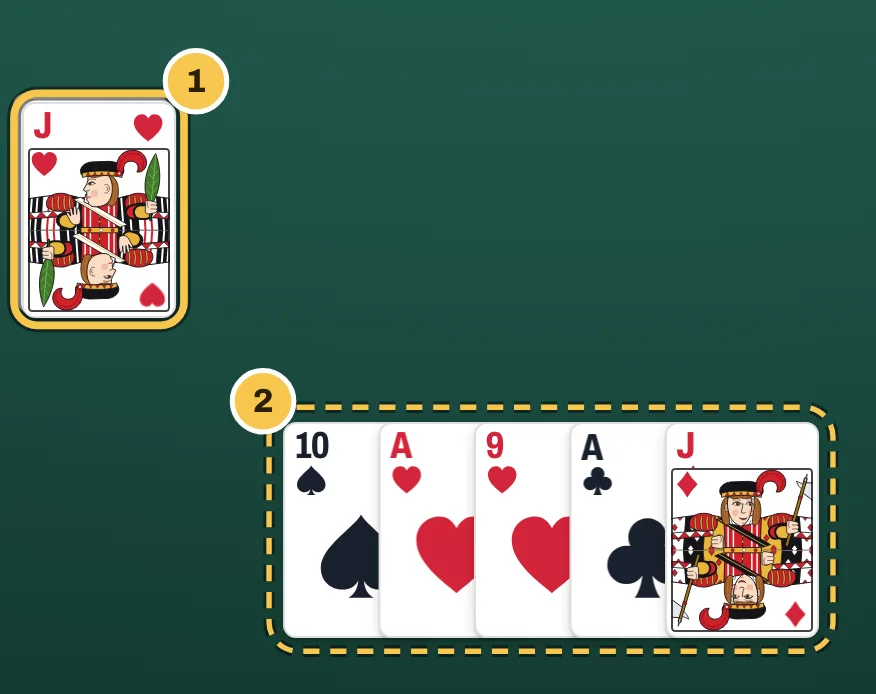
Order it up when your hand is worth about three tricks with that suit as trump, counting the turned card for whoever will get it: add it when your partner deals, subtract it when an opponent deals, and count it in your own hand when you deal. That’s why the same five cards can be a pass in one seat and a lone hand in another.
Every call in this article was checked against our Euchre game: the computer players decide this way, and Hint suggests the same call for your hand.
Count your hand first
With the turned card’s suit as trump, add up what your cards are worth in tricks. Roughly:
- The right bower (the Jack of trump) is a sure trick: 1.
- The left bower (the other Jack of the same color) is nearly as good: 1 if you also hold the right, ¾ if you don’t.
- The Ace of trump is worth ¾, the King ½, and the Queen, 10 or 9 about ⅓.
- Every trump after your second adds another ¼. Long trumps win the tricks the others can’t follow.
- An Ace of another suit is worth ¾ when it’s alone or has one card with it, a little less in a longer suit. A King with another card of its suit adds a little.
- An empty suit adds ¼ when you hold two trumps or more, since you can trump it when it’s led.
Take the hand in the picture with hearts as trump. The J♦ is the left bower (¾, without the J♥), the A♥ ¾, the 9♥ ⅓, a third trump ¼, the A♣ ¾, and with the J♦ counting as a heart you have no diamonds: ¼ more. That comes to about 3.
Three trumps, one of them a bower, with an Ace on the side: that’s the hand our guide calls a likely three tricks, and the count agrees.
Then count the turned card for whoever gets it
Whoever orders it up, the dealer picks up the turned card and discards. So the card goes to the dealer’s side, and how much it matters depends on whose side that is. Our computer players order it up when the total reaches about 2½ (2.6, to be exact).
- Your partner deals. The card goes to your side: add most of its value. With the J♥, a whole trick, the hand above comes to about 3¾. Order it up.
- An opponent deals, whether you sit at the dealer’s left or right. The card strengthens the other side: subtract a little over half its value. The same hand drops to about 2½, just short. Pass.
- You deal. Count the hand you’d have after picking the card up and discarding your weakest card.
A turned Jack is the biggest swing of all, because it’s the right bower. A turned 9 changes very little, so there your own cards decide.
When you deal: pick it up, then discard well
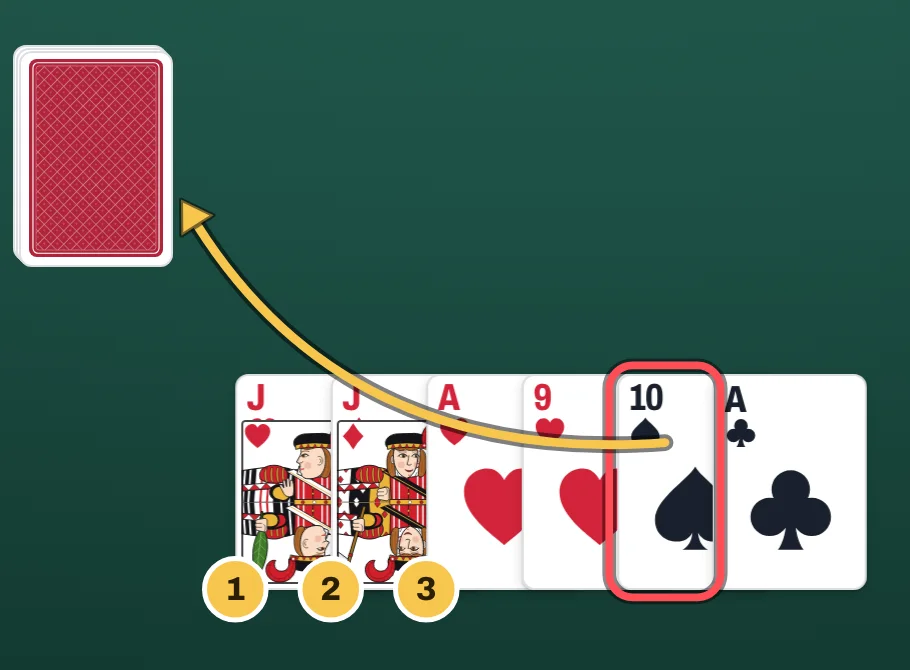
With the J♥ in your hand, the same cards hold the three highest trumps. Throw away the 10♠, which leaves you with no spades, and every card left is likely to win a trick. That’s a lone hand: take all five and your side scores 4 points instead of 2.
Discard a single card of a side suit when you can. An empty suit lets you trump it, and a lone low card would only lose a trick anyway. Keep your trumps and Aces.
The second round: naming a suit
If all four players pass, the turned card is turned down, and its suit is out for this hand: nobody can name it. Going round again from the dealer’s left, each player may name any other suit as trump, or pass.
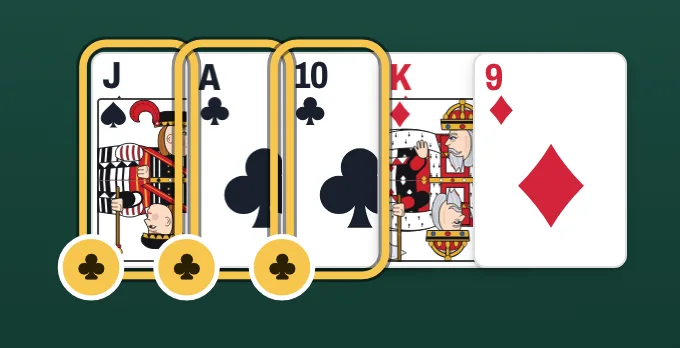
Count each suit you could name the same way. Here clubs come to almost 3: three trumps, one a bower, no hearts and, with the J♠ counted as a club, no spades. That’s enough to name clubs from any seat. Diamonds, with only the K♦ and 9♦, are far weaker.
In the second round our computer players want a little more than in the first, about 2.65, because nobody gains an extra card. The exception is the dealer, last to speak, who names a suit with a little less, about 2.4. If the dealer passes too, the cards are thrown in, nobody scores and the next player deals.
Mistakes that cost points
- Ordering up an opponent’s dealer on a close hand. You hand them a trump, and if you take fewer than three tricks, they score 2.
- Passing a strong hand to name the same suit later. Once the card is turned down, its suit can’t be named.
- Counting the left bower in its own suit. The J♦ is a heart when hearts are trump, which can leave you with no diamonds at all.
- Going alone without the top trumps. A lone hand needs every card to be a winner. Taking only three or four tricks alone scores 1, the same as with your partner.
Practise on Card Gamez
On our Euchre page, decide before you tap, then press Hint: it suggests a call from the same count used here, and as dealer it also suggests what to discard. After each hand a table shows both sides’ tricks and points, so you can see whether your call paid. A game to 5, chosen under New, is the quicker one.
The full rules and the scoring table are in the Euchre guide.