How many cards can you move at once in FreeCell?
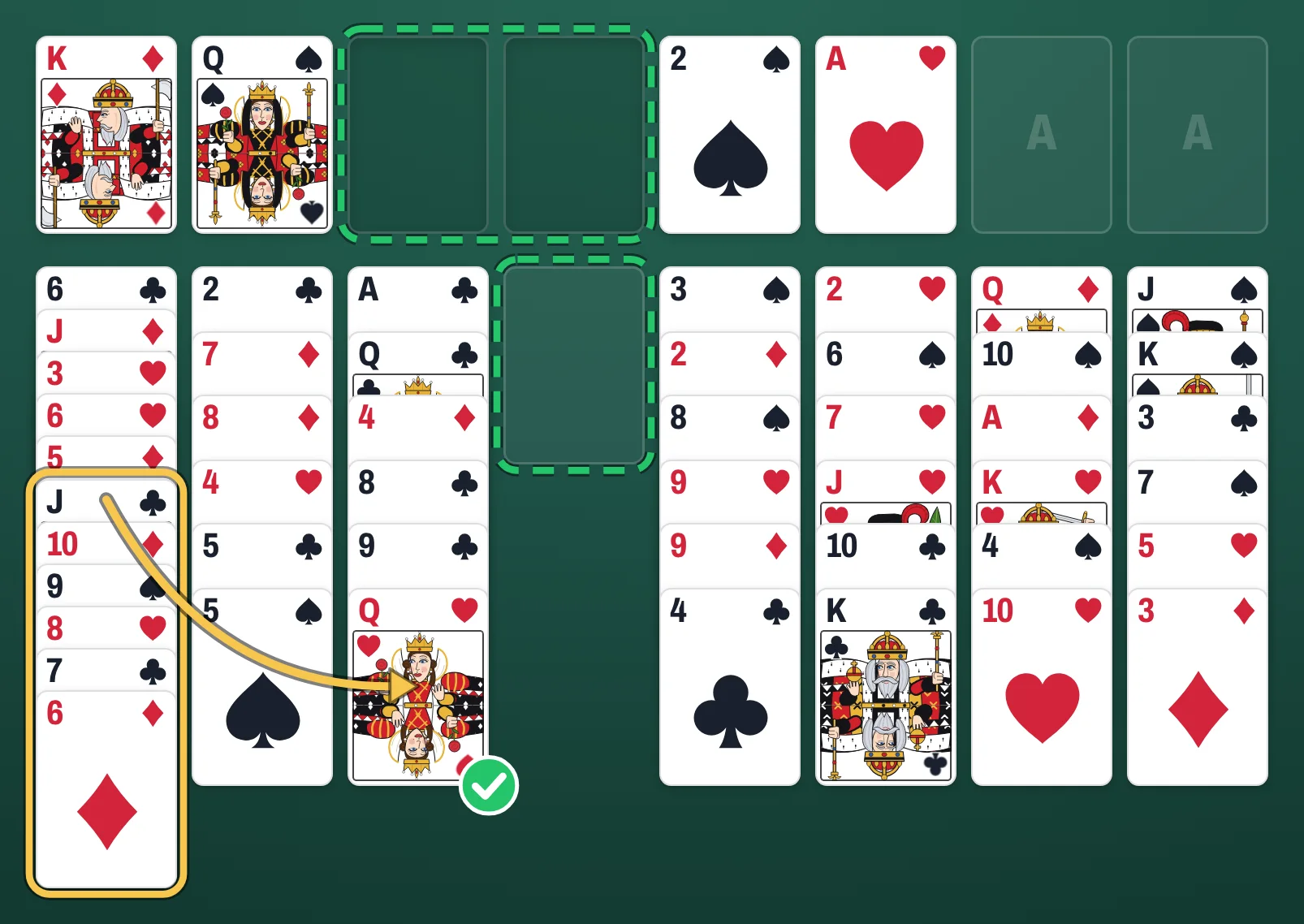
In FreeCell you can move as many cards at once as your empty free cells plus one, doubled for every empty column. With two free cells and one empty column that’s (2 + 1) × 2 = 6 cards. If the cards are going into an empty column, that column doesn’t count. The rule isn’t arbitrary: it’s exactly how many cards you could move one at a time using the space you have.
Our FreeCell game does this sum for you. Drag a run and it moves in one go if there’s room, and Undo takes it back in one go too.
The rule in a table
The cards must already be a run: each one lower than the card above it and the other color, like a black J, red 10, black 9. The first card of the run must also fit where it’s going. Then the limit is:
| Empty free cells | No empty column | 1 empty column | 2 empty columns |
|---|---|---|---|
| 0 | 1 | 2 | 4 |
| 1 | 2 | 4 | 8 |
| 2 | 3 | 6 | 12 |
| 3 | 4 | 8 | 16 |
| 4 | 5 | 10 | 20 |
If the run is longer than the limit, the game says how many cards the move needs and how much room you have.
Why each free cell adds one card
A free cell holds one card, so it lets you set one card aside. To move three cards with two empty free cells, you put the last card of the run in one cell and the card before it in the other, move the remaining card across, then put the two back on it in order. Each empty cell is one more card you can set aside, plus the card that moves across: that’s the “plus one”.
Why an empty column doubles it
An empty column holds a whole run, not just one card. So you can move half the run into it, using your free cells, move the other half to where it’s going, using the same free cells again, and then bring the first half across.
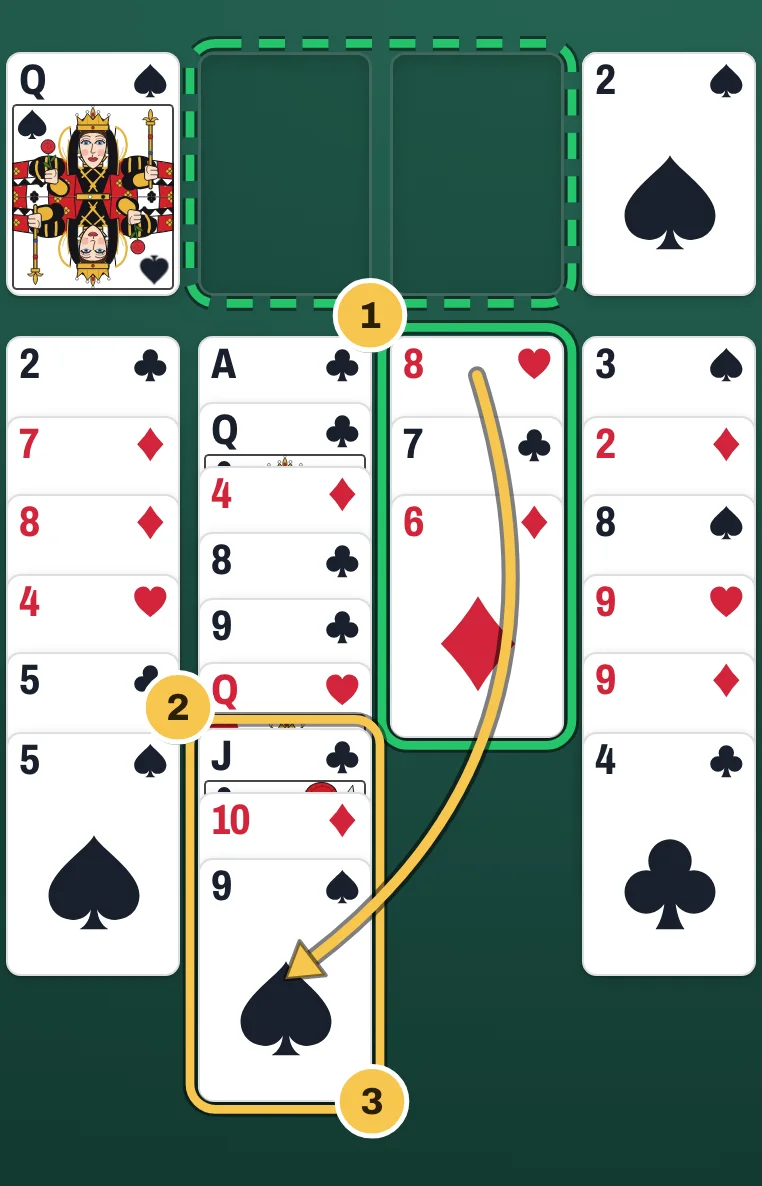
Each half is three cards, the most two free cells can move, so six cards in all. A second empty column doubles it again: the first half itself can be split between the two columns.
Moving into an empty column halves the limit
When the run is going into the empty column, that column can’t also be the place you park half of it. So it doesn’t count, and the limit drops back to what the other spaces allow.
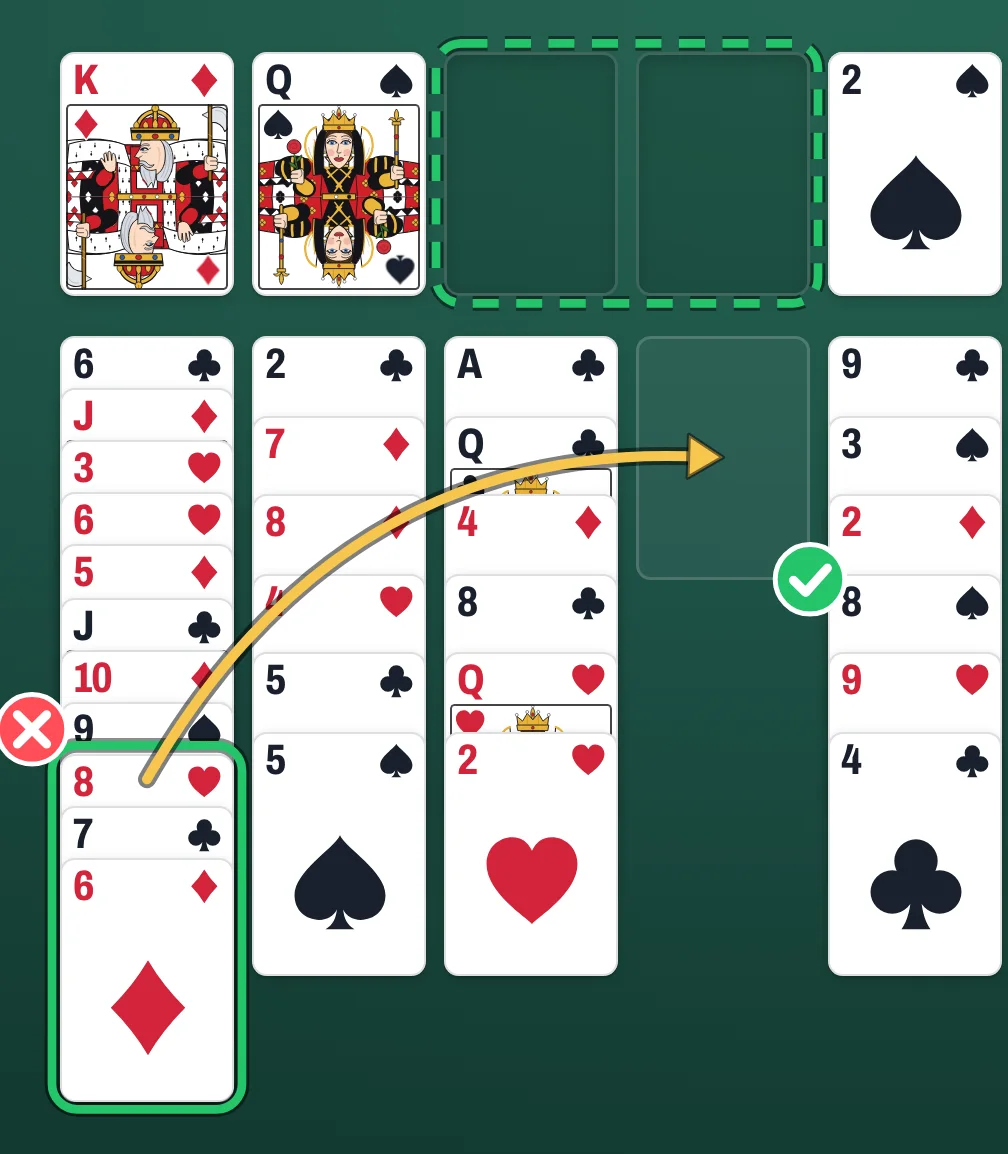
The same table that moves six cards onto the Q♥ can move only three into the empty column. If you want the longer run there, free another cell first, or move it in two steps.
Planning a long move
- Count before you build. If a run will be too long to move, free a cell or a column before you need it, not after.
- An empty column is worth more than a free cell. With two free cells, one more cell lets you move 4 cards. An empty column instead lets you move 6.
- Keep the last free cell empty. Parking a card in it to make a small move can cut a long move you need later in half.
- Move part of a run. You don’t have to move a whole run. Drag from any card in it, and that card moves together with the cards lying on it.
- Split a long run yourself. If a run is too long, move its lower part onto another card that fits, then move the rest. It’s the same trick the game uses, done by hand.
Mistakes that block a move
- Counting the column you’re moving into. It’s the target, so it can’t help with the move.
- Forgetting the colors. Cards only move together if they alternate red and black, each one lower than the last. Two reds in a row break the run.
- Filling free cells to make room. Every card you park makes the next long move shorter.
Practise on Card Gamez
On our FreeCell page, before you drag a run, count your empty free cells and columns and work out the limit yourself. If you’re one card short, look for a cell or a column you can free first. Hint looks ahead for a way to win and shows the next move on it, and Undo takes back as many moves as you like.
The full rules, the numbered deals and the controls are in the FreeCell guide.