How to bid in Spades: count your hand card by card
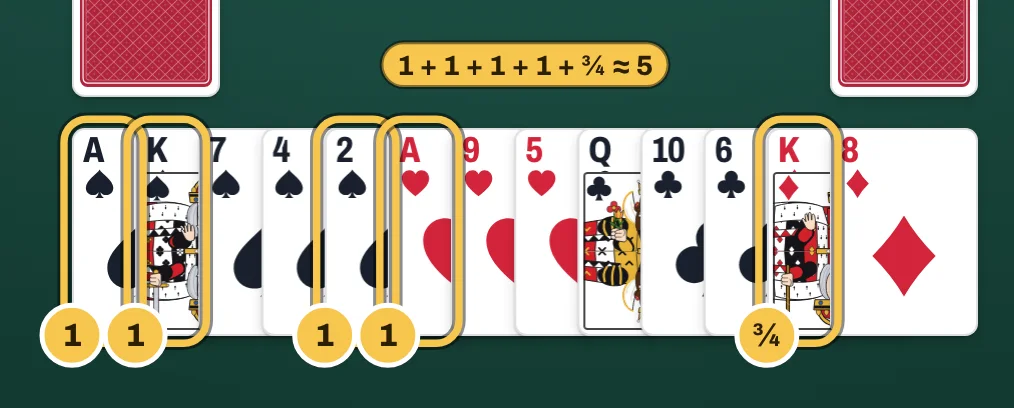
To bid in Spades, count the tricks your hand can take on its own: each Ace, each King with a small card beside it, your high spades, every spade past the fourth, and a missing or single side suit when you have spades to trump with. Add them up, round to the nearest whole trick, and that’s your bid. Your partner’s bid is added to yours, so count only your own cards.
Every hand below was checked against our Spades game: the computer players bid with this same count, and Hint suggests the same number for your hand.
Start with your spades
Spades are trump, so your high spades take tricks almost whatever happens, and long spades take extra tricks once everyone else has run out.
- The Ace of spades is a sure trick: 1.
- The King of spades is 1 if you hold at least one other spade, because you can play the small one while the Ace is still out. Alone, count it as half.
- The Queen of spades is nearly a trick with two or more spades beside it. With fewer, it usually falls under the Ace or King.
- The Jack of spades is worth about half a trick, and only in a hand with four or more spades.
- Every spade after your fourth is worth about one more trick, even a 2. By the time the others have played their spades, yours are the only trump left.
In the hand at the top, the A♠ and K♠ count 1 each, and with five spades the fifth one adds another: 3 tricks from spades alone.
Then Aces and Kings in the other suits
- An Ace is a trick, unless its suit is very long. With seven or more cards of one suit, someone else is likely to be out of it early and trump your Ace.
- A King with one to four other cards of its suit is most of a trick: count ¾. A bare King is caught by the Ace too easily, and a King in a long suit is likely to be trumped, so count either as ¼.
- A Queen outside spades is rarely a trick. Give it a third only when it has two or three cards with it.
That gives the hand at the top 1 for the A♥ and ¾ for the K♦, guarded by the 8♦. The Q♣ with two clubs adds a little. In all: 1 + 1 + 1 + 1 + ¾, plus a bit, about 5.
Short suits and voids
A suit you don’t have is a trick waiting to happen: when it’s led, you can trump it. That only works if you have spades to spare, so count it only with three or more spades.
- No cards in a suit (a void): add 1.
- A single card in a suit (a singleton): add ½.
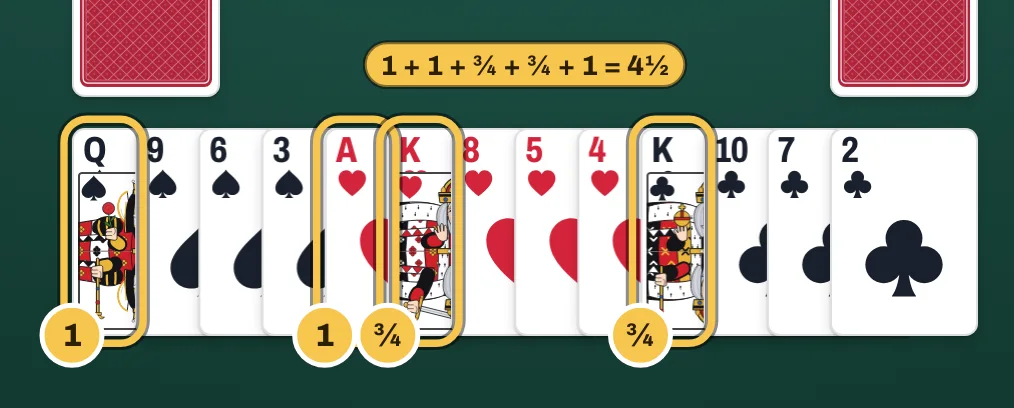
This hand has no diamonds, so the first diamond led can go to one of its small spades. Count the void as a trick, and the total comes to 4½.
Round it, and when in doubt, round down
Your count will rarely be a whole number. Round it to the nearest one, and when it lands on a half, take the lower number: 4½ bids 4, 4¾ bids 5. That’s how our computer players round, and there’s a reason. Missing a bid costs 10 points for every trick you bid, while one extra trick costs only a bag.
Bid 5 and take 4: your side loses 50. Bid 4 and take 5: it scores 41, 40 for the bid and 1 for the bag.
Don’t take that too far. Bags add up over the whole game, and every tenth bag costs your side 100 points. Bid one short every hand and those 100 points come off your score sooner or later.
Read the other bids
There are only 13 tricks. When it’s your turn, the bid panel lists the bids already made, and after the bidding the name tags show everyone’s, so add them up:
- 13 or more in all: the hand will be tight, and at 14 or more at least one side must fall short. Every trick you win counts.
- Well under 13: there will be spare tricks, and they become bags for whoever takes them. Once your side has its bid, play low.
Your bid and North’s are added together, and either of you can take the tricks. If North bids 4 and you bid 3, your side needs 7, no matter who wins them.
When to bid Nil
Nil is a promise to take no tricks at all. Keep it and your side scores 100; take even one trick and it loses 100. North still plays for their own bid, but the tricks you take on a failed Nil don’t count toward it. They only count as bags.
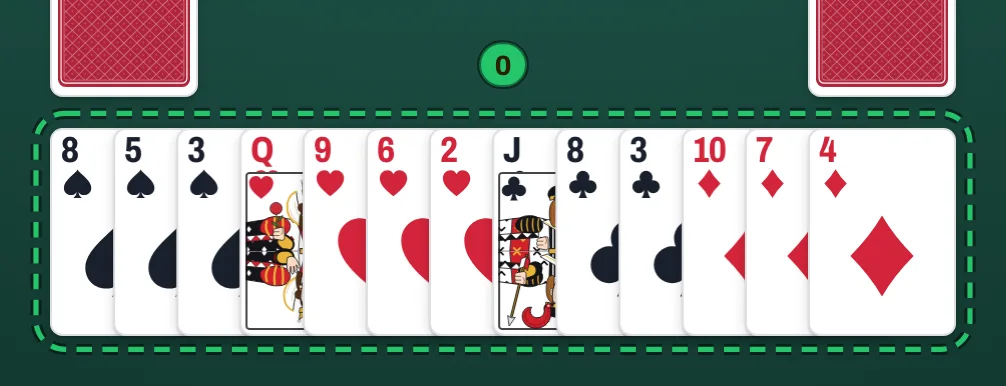
A good Nil hand has no Aces, no spade higher than the Jack, three spades or fewer, and adds up to less than one trick. Low cards in every suit help, because you can play under whatever is led. A hand with a lone high card in a long suit, or four small spades, is a risk: sooner or later you may have to win a trick with it.
When North bids Nil, your job changes. Try to win the tricks North might otherwise be forced to take, even ones your own bid doesn’t need. North does the same for you when you bid Nil.
Mistakes that cost bids
- Counting a bare King as a trick. The Ace takes it whenever its holder likes.
- Counting every Ace in a long suit. With seven cards of one suit, expect the others to trump it.
- Counting a void without spades. You can only trump with a spade you have.
- Adding your partner’s cards to your count. North bids for North. Your bids are added, not your guesses.
- Bidding low on purpose every hand. The bags come back as a 100-point penalty.
Practise bidding on Card Gamez
On our Spades page, count your hand before you bid, then press Hint: it suggests a bid from the same count used here, so you can see where yours differs. After each hand a table shows every side’s bid, tricks and points, and the bags each side has collected. If you’d rather finish a game in one sitting, choose 250 points under New.
The full rules and scoring table are in the Spades guide.