Spider Solitaire with 2 suits: how to choose your moves
In two-suit Spider most cards fit in more than one place, and which place you pick decides the game. Put a card on its own suit when you can, accept an off-suit spot when it turns over a face-down card, keep empty columns for untangling mixed stacks, and make every useful move before you deal. Here’s why each of those works, with positions from our game.
Every move in the pictures was checked by the rules of our Spider Solitaire game, where you choose 2 suits under New.
What changes when you add a second suit
With 1 suit every card is a spade, so any stack in order is a run that moves as one. With 2 suits the 104 cards are spades and hearts: eight of every rank, four of each suit.
The rules don’t change. Any card still goes on any card one rank higher, but only cards in order and in one suit move together. Put a 7♥ on an 8♠ and the 7♥ can leave on its own, but the 8♠ can never take it along. That’s a mixed stack, and each one is a knot you’ll have to untie later, usually with an empty column.
So the real question on most moves isn’t “can this card move?” but “is this knot worth tying?”
An order for choosing between moves
When several moves are open, go down this list and take the first one that fits:
- Finish a run. King to Ace in one suit leaves the table by itself and turns over the card beneath it.
- Turn over a face-down card, in suit. You gain a card and tie no knot.
- Turn over a face-down card, off suit. The new card is usually worth the knot.
- Move a card onto its own suit. Taking a 6♥ off a 7♠ and putting it on a 7♥ unties a knot for free.
- Anything else only when you can say what it sets up.
Our game’s Hint weighs moves in much the same way: a card turned over counts for far more than a tidy stack, and a pair in suit for more than a mixed one.
Same suit or off suit: two moves that both turn a card over
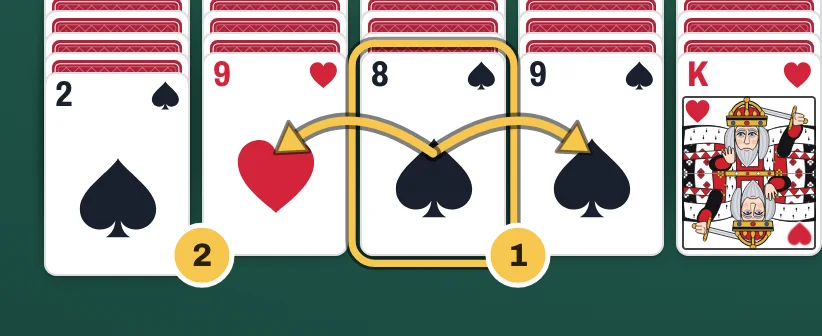
In the picture at the top, the 8♠ sits on face-down cards, and two 9s are open: the 9♥ and the 9♠. Either move turns over the card under the 8♠, so look at what each leaves behind.
On the 9♠, the 9♠ and 8♠ become a run that moves as one, and a 7♠ can join it later. On the 9♥, the 8♠ is stuck to it until you untie the pair. When two moves gain the same thing, the one in suit is better.
When an off-suit move is worth it
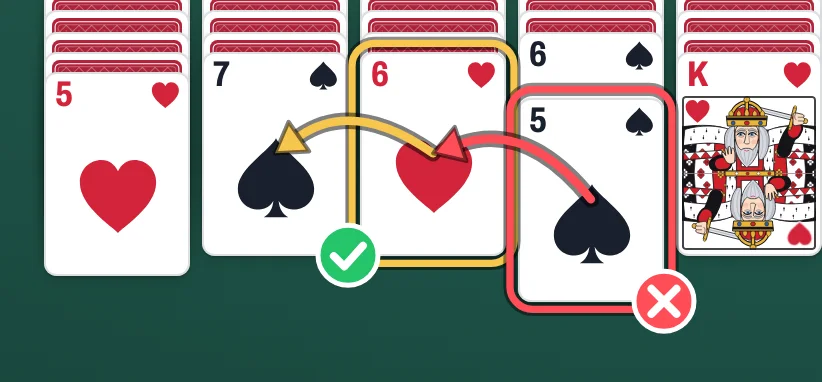
A hidden card is worth more than a tidy stack. You can’t plan with a card you can’t see, and you’ll have to dig down to every one of them before the game is won. So when no 7♥ is open, putting the 6♥ on the 7♠ is a good move: it ties a knot, but it turns a card over.
The same spot is a bad move for the 5♠. It already sits on the 6♠, in suit, and moving it onto the 6♥ turns over nothing. You’d swap a pair that moves together for one that doesn’t.
The exception to the rule: think twice before covering a card you were saving. If you meant that 7♠ for a 6♠ from another column, the 6♥ would take its place.
Use empty columns to untangle mixed stacks
Any card, or any run in one suit, can go into an empty column, not only a King. That makes an empty column the best tool in two-suit Spider: a place to set a card down while you rearrange the others.
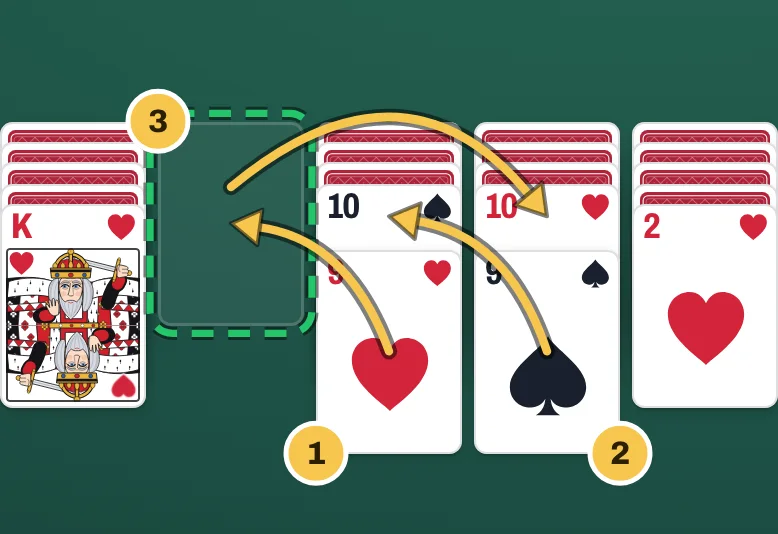
Here the 9♥ sits on the 10♠ and the 9♠ on the 10♥: two knots. With one empty column it takes three moves to untie both, and you get the empty column back at the end.
What doesn’t pay is filling an empty column with a single card that frees nothing. You can’t deal while a column is empty, so it will have to be filled before the next deal anyway. Keep it open while it’s useful, and when the time comes to deal, fill it with the card that costs you least. If filling it is the only way to deal, Hint suggests which card to put there.
Kings are the one card that can only move into an empty column. A King lying on face-down cards stays there until you clear a column for it, so when you have one, moving the King (and any run on it) is often the best use of the space.
Before you deal from the stock
A deal puts one card face up on every column, so it lands on top of everything you were building. The stock holds five deals of ten cards. Before you tap it:
- Fill every column. The game won’t deal while one is empty.
- Make every move that turns over a card. After the deal, that card may be buried again.
- Join runs of the same suit. A run in one piece moves in one go once you’ve moved the dealt card off it.
Hint suggests dealing only when it finds no useful move left. And Undo takes back a deal too. The stock deals the same cards in the same order, so you can undo, rearrange, and deal again knowing what’s coming.
Mistakes that cost two-suit games
- Taking the first spot a card fits. Check whether a card of the same rank in its own suit is open first.
- Off-suit moves that turn over nothing. Each one is a knot with nothing gained.
- Breaking up a run in suit for no reason. You can pick up part of a run from any of its cards, but only do it when the move gains something.
- Parking a single card in an empty column. The space is worth more than the move.
- Dealing with useful moves left. Every one you skip may be buried by the deal.
Practise two suits on Card Gamez
On our Spider page, tap New and pick 2 suits. Hint shows a useful move, and Undo takes back as many moves as you like, so when two moves look equally good you can try one, undo it and try the other. When two suits starts to feel easy, 4 suits asks the same questions on almost every move.
The full rules, the scoring and the controls are in the Spider Solitaire guide.