Sudoku solving techniques, from singles to X-Wing
Every Sudoku on Card Gamez has exactly one solution, and you never need to guess to find it. You need the right techniques, used in the right order. This guide goes from the simplest to the more advanced, with an example for each. Try them on our Sudoku page.
The words we use
- A unit is a row, a column or a box of three by three cells. Each unit must hold the digits 1 to 9 once.
- A cell sees every other cell in its row, its column and its box.
- Candidates are the digits a cell could still hold, written as pencil marks.
1. Scanning
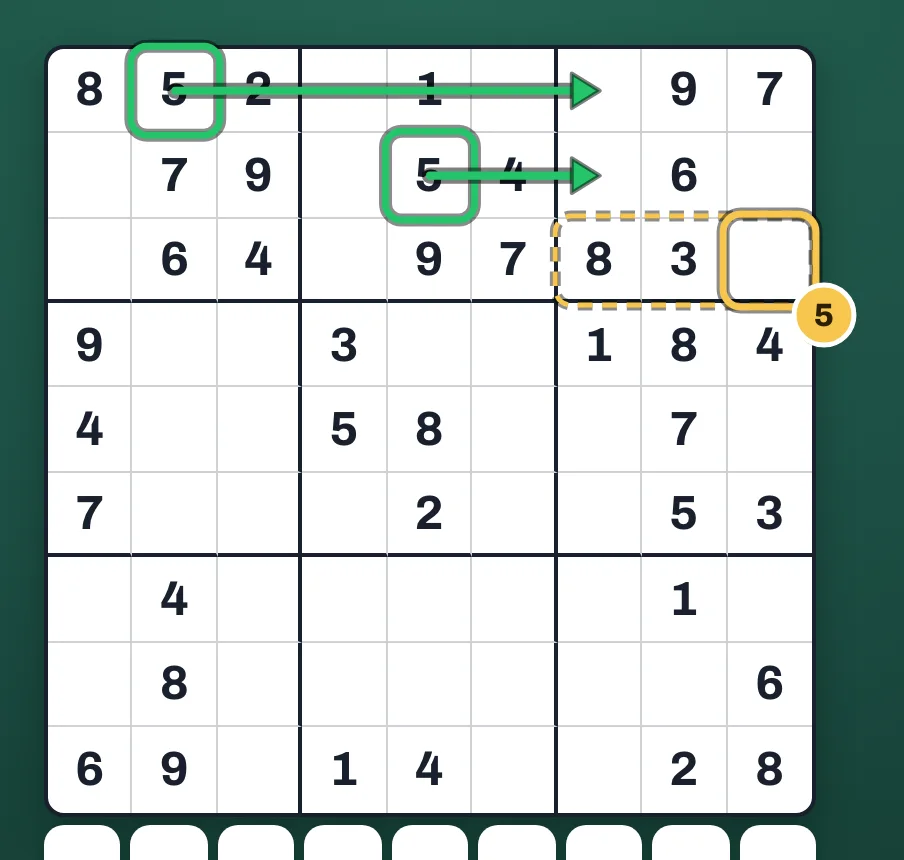
Pick a digit and look where it already stands. Every 5 in the grid rules out its row, its column and its box for any other 5. Follow those lines across a band of three boxes, and often only one cell is left where the 5 can go in the remaining box. This is also called cross-hatching.
Example: in the top band, there is a 5 in the first row of the left box and a 5 in the second row of the middle box. In the right box, the 5 can only go in the third row. If two of the three cells there are already filled, the 5 goes in the last one.
Go through the digits 1 to 9 one after another. Scanning alone solves most of an Easy puzzle.
2. Naked single: a cell with one candidate
Look at one empty cell and count the different digits it sees. If eight different digits stand in its row, column and box together, the ninth is the cell’s digit.
Example: a cell’s row holds 1, 3, 7 and 9, its column 2, 4 and 7, and its box 6 and 8. Together it sees 1, 2, 3, 4, 6, 7, 8 and 9. The only digit left is 5.
3. Hidden single: a digit with one place
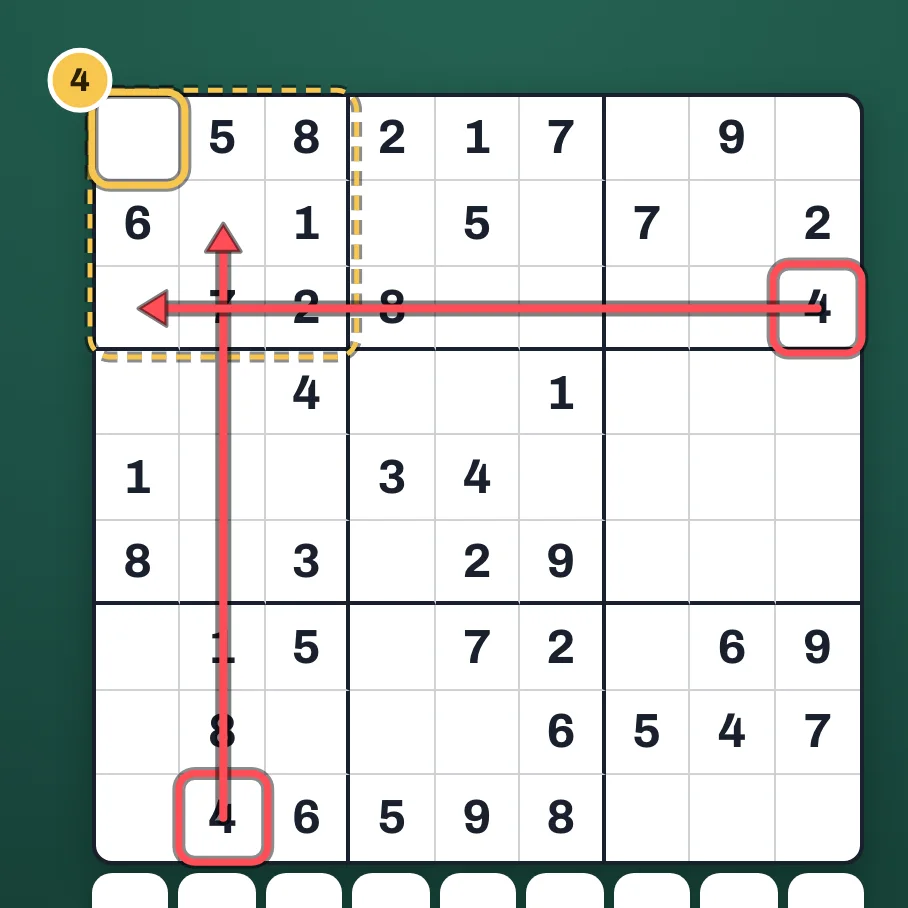
Turn the question round: for one unit and one digit, where can that digit go? If only one cell of the row, column or box can take it, it belongs there, even if that cell still has other candidates.
Example: a box still needs a 4 and has three empty cells. One of them is in a column that already has a 4, and another in a row that already has a 4. The 4 must go in the third cell.
Naked and hidden singles are all you need for the Easy and Medium puzzles here.
4. Pencil marks
On harder puzzles, write the candidates in each empty cell. On Card Gamez, tap Notes, choose a cell and tap the digits that are still possible. When you place a digit, its pencil marks in the same row, column and box are removed for you. With candidates in place, the next techniques become visible.
5. Naked pair
If two cells in the same unit have exactly the same two candidates, those two digits must go in those two cells, in one order or the other. No other cell of that unit can hold them, so you can remove them from the rest of the unit.
Example: in a row, two cells both have only the candidates 2 and 7. Remove 2 and 7 from every other cell of the row. If another cell had the candidates 2, 5 and 7, it is now a 5.
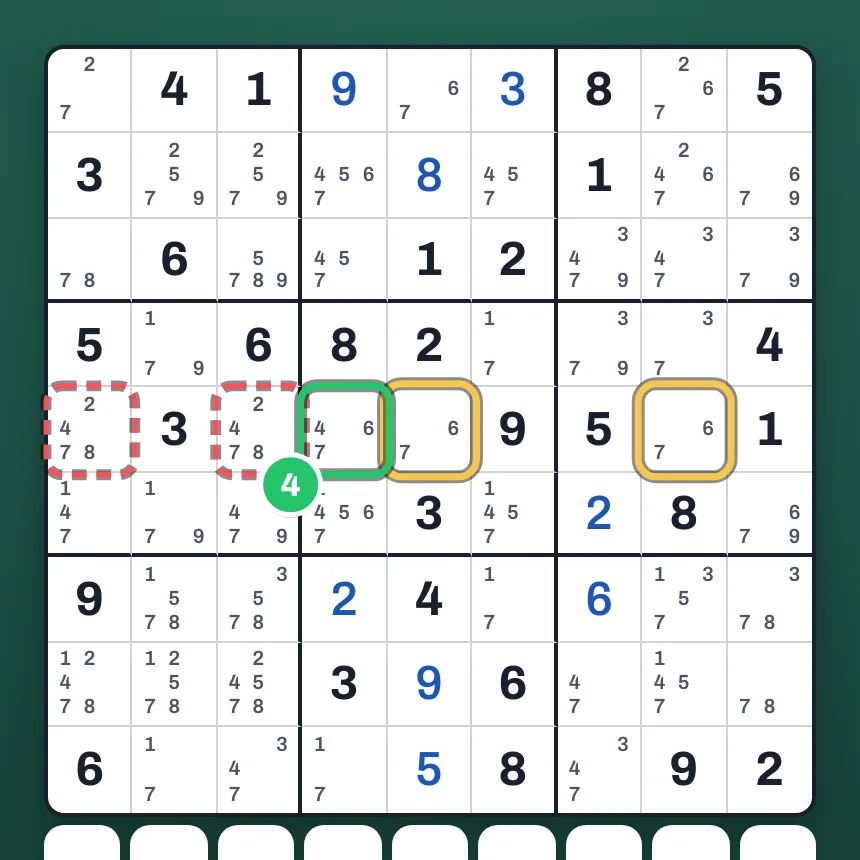
The same works with three cells and three digits, a naked triple: three cells whose candidates together are only, say, 1, 4 and 8.
6. Hidden pair
If two digits can each go only in the same two cells of a unit, those two cells must hold those two digits. Any other candidates in the two cells can be removed.
Example: in a box, the 3 and the 6 can each only go in the same two cells, whose candidates are 1, 3, 6 and 3, 6, 9. Those cells become 3, 6 and 3, 6, so the 1 and the 9 are crossed out there.
7. Pointing: when a box points along a line
If, inside a box, all the candidates for a digit lie in one row (or one column), the digit must go in that row within this box. So it can’t go anywhere else in that row, in the other two boxes.
Example: in the top-left box, the only cells that can hold a 9 are both in the second row. Then no other cell of the second row, in the top-middle or top-right box, can be a 9.
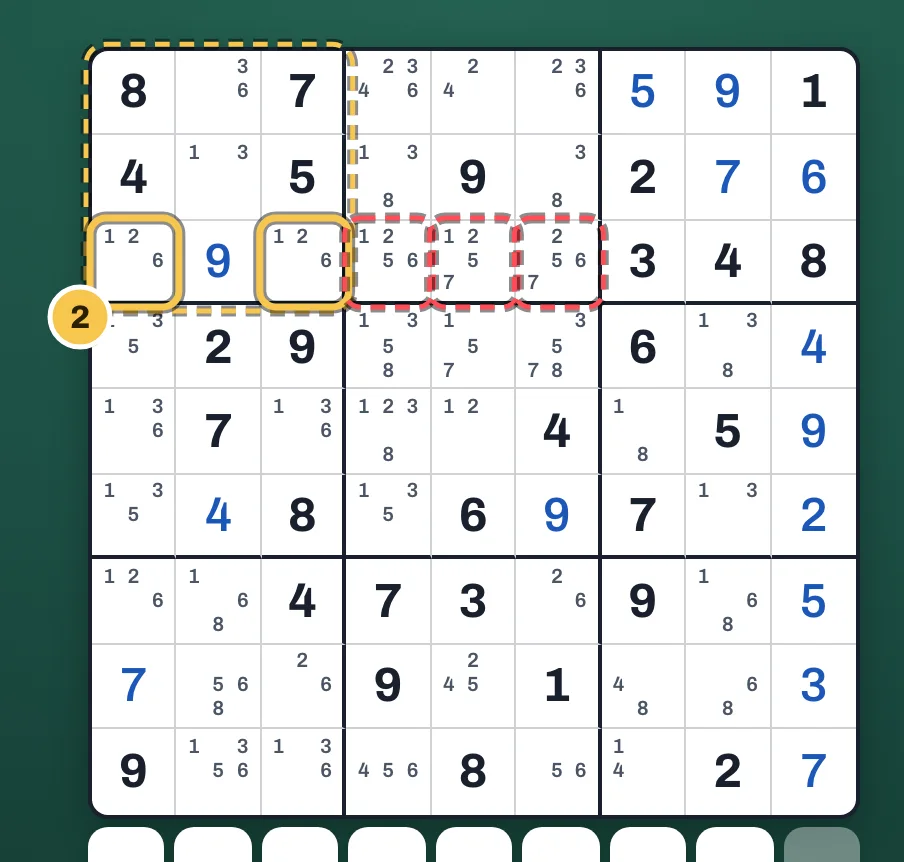
The reverse also works, and is called box-line reduction: if in a row all the candidates for a digit lie in one box, remove that digit from the other cells of the box.
8. X-Wing
X-Wing is the first of the “pattern” techniques. Take one digit. If in two different rows it can go in only two cells each, and those cells are in the same two columns, the four cells form a rectangle. The digit must be in two opposite corners, whichever way round, so it fills both columns. You can remove it from every other cell of those two columns.
Example: in rows 2 and 7, the digit 4 can only go in columns 3 and 8. So the 4s of columns 3 and 8 are in rows 2 and 7, and 4 can be crossed out from every other cell of columns 3 and 8.
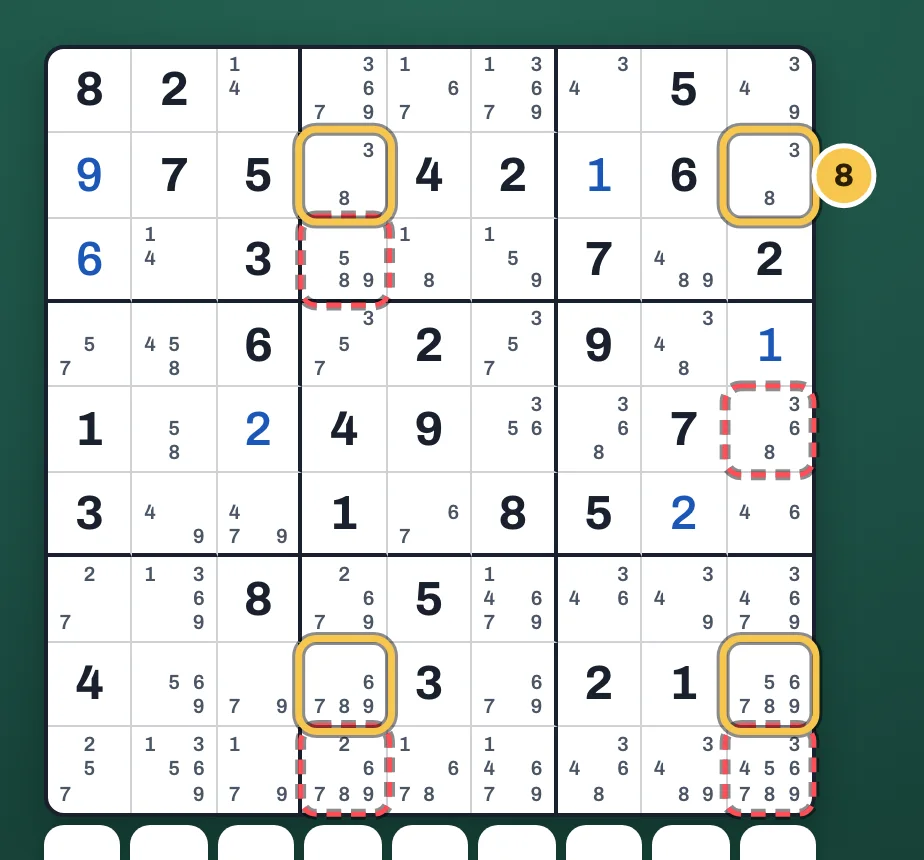
The same pattern works with columns and rows swapped.
A good order to work in
- Scan the digits 1 to 9 across the grid.
- Look for naked and hidden singles, starting where units are fullest.
- When singles run out, fill in pencil marks.
- Look for pairs, then pointing, then X-Wing.
- After every technique that removes candidates, go back to looking for singles.
Mistakes to avoid
- Forgetting the box. Many errors come from checking the row and column but not the box.
- Guessing. A guess may look fine now and break the puzzle twenty cells later.
- Building on a wrong digit. On Card Gamez a wrong digit turns red. Erase it before you go on.
Which level should you play?
Easy starts with 40 digits and needs only singles. Medium has fewer digits but can still be solved with singles, without pencil marks. Hard starts with about 28 digits and usually needs pencil marks, and Expert starts with as few as 24. If you’re stuck, Hint chooses a cell you can fill now and tells you why, and if one of your digits is wrong, it points to that one first.