Turn 1 or Turn 3: what really changes in Klondike
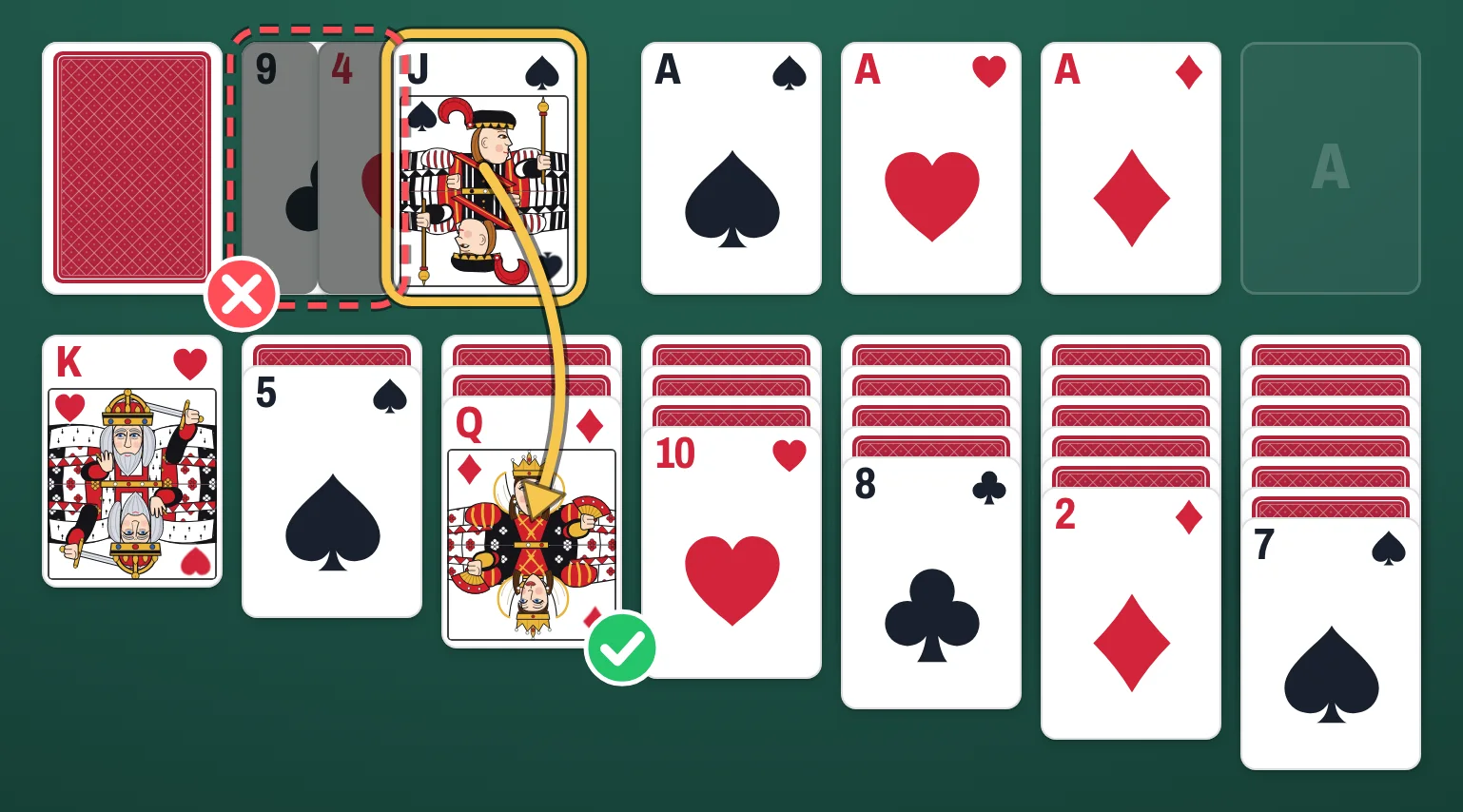
Klondike Solitaire comes in two modes, Turn 1 and Turn 3 (also called Draw 1 and Draw 3). The deal and the rules are the same in both. Only one thing changes, how the stock is turned over, and that one change makes them feel like different games.
The one rule that differs
In Turn 1, each tap on the stock turns over one card onto the waste. In Turn 3, each tap turns over three cards, and only the top one of the three can be played. The cards under it become playable only after the cards above them have been used.
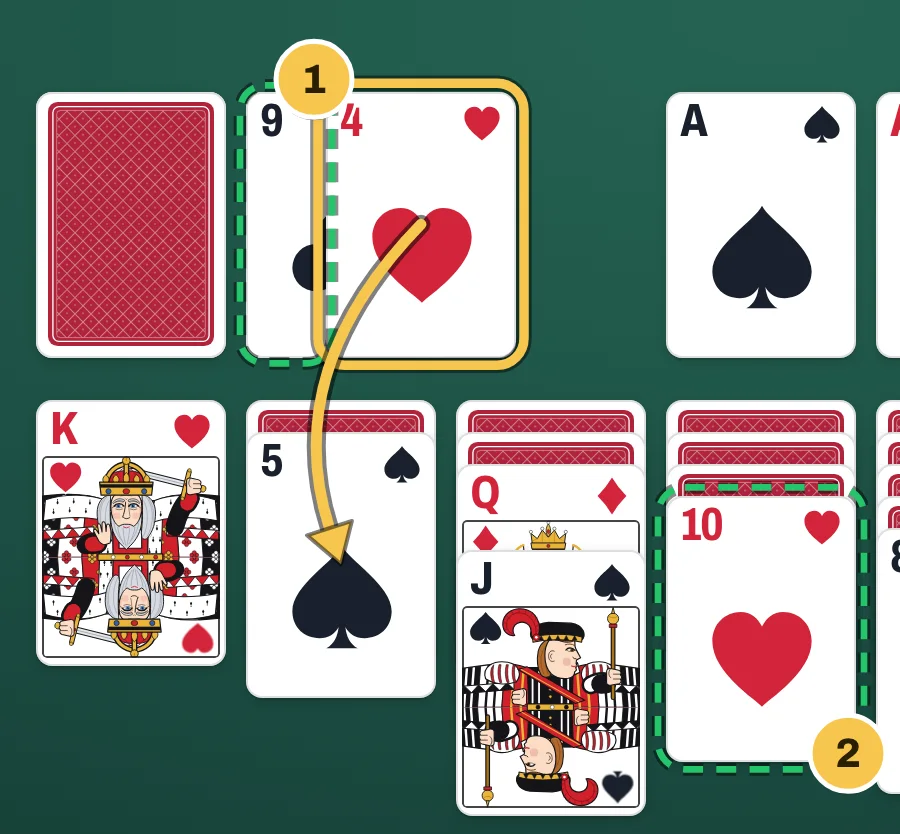
Everything else stays the same: seven columns, 24 cards in the stock, building down in alternating colors and up by suit on the foundations. On Card Gamez you can go through the stock as many times as you like in both modes.
How much of the stock can you reach?
In Turn 1 you see every one of the 24 stock cards on every pass. In Turn 3, if you play nothing from the waste, the same cards come up each time: only the third, sixth, ninth card and so on, eight cards out of 24. The other sixteen are out of reach.
Turn 3, first pass: the stock is turned in groups of three: cards 1–2–3, 4–5–6 … 22–23–24. You can play cards 3, 6, 9, 12, 15, 18, 21 and 24.
After you play card 3: 23 cards are left, and on the next pass the groups shift to 1–2–4, 5–6–7, 8–9–10 … 20–21–22, then 23–24 on their own. Now you can reach cards 4, 7, 10, 13, 16, 19, 22 and 24.
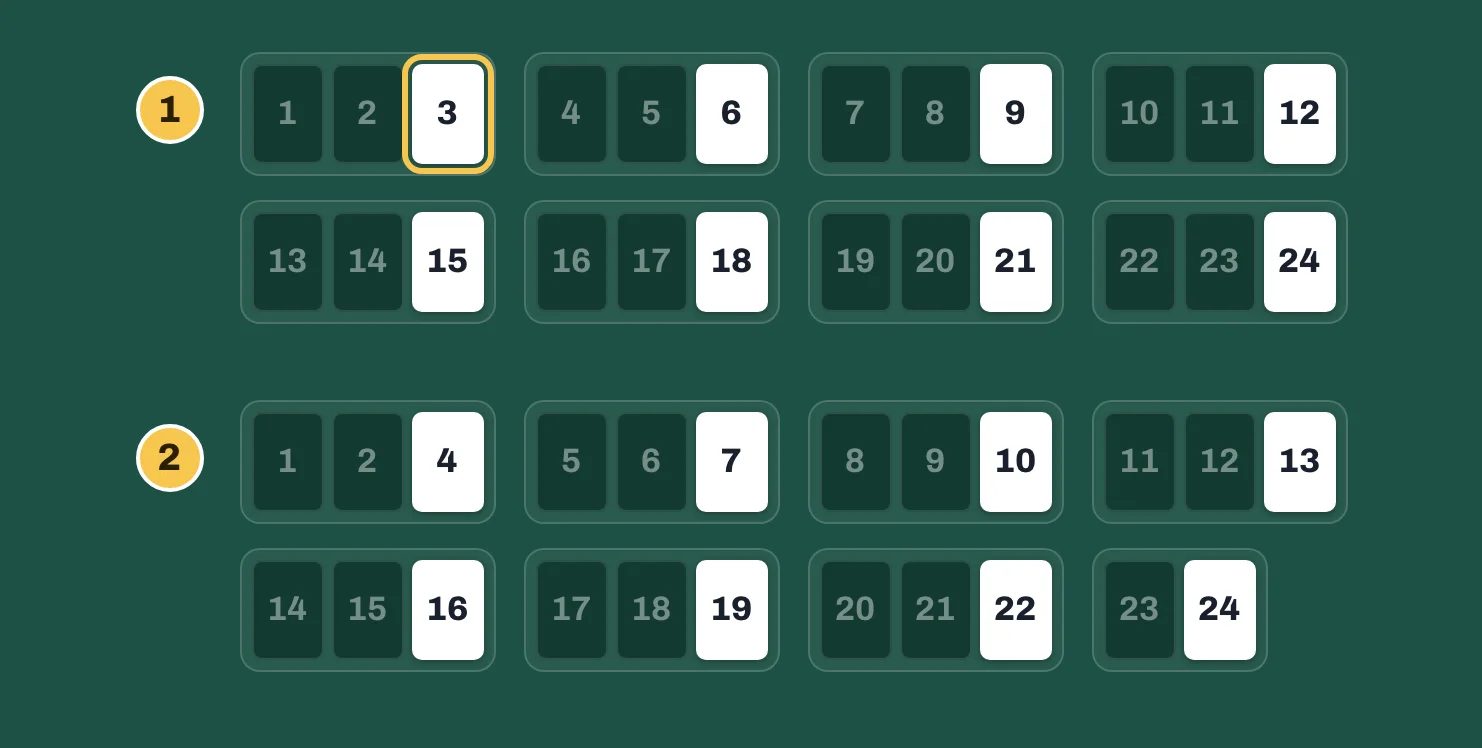
Each card you play from the waste moves the groups after it, and new cards come within reach. That is the heart of Turn 3: the stock is a puzzle of its own, and the order in which you take its cards decides which others you will see.
Which is harder?
Turn 3, clearly. With most of the stock hidden behind other cards, you often can’t get the one card you need, and more games end with no useful move. Turn 1 lets you reach any stock card on any pass, so it forgives more mistakes. Neither mode can win every deal: some are lost however you play. Researchers at the University of St Andrews estimated that about 82% of Turn 3 deals (and about 90% of Turn 1 deals) could be won by a perfect player who could see every card, and with face-down cards in the way, real win rates are much lower.
Scoring in each mode
The points for moves are the same in both modes: for example, +5 for playing a waste card to a column and +10 for each card that reaches a foundation. The difference is the cost of going round again. In Turn 1, turning the waste back over costs 100 points, because seeing every card again is a big advantage. In Turn 3 it costs nothing. The full table is in the Klondike guide.
Playing Turn 1 well
- Learn the stock. After one pass you’ve seen every stock card. Notice where the Aces, the 2s and the Kings are, so you know what’s coming.
- Don’t take a card just because it fits. Since you’ll see it again on the next pass, a waste card can wait until it’s really useful.
- Keep your passes for scoring. If you care about points, each extra pass costs 100, so plan to need as few as you can.
Playing Turn 3 well
- Go through the whole stock first. Before your first play from the waste, turn the stock over once and see which cards come up. You can then choose which plays will open the most new cards.
- Count the shift. Each card taken from the waste moves every later group by one card. Sometimes holding back a play keeps a card you need in a position you can reach.
- Play the last group with care. The final turn of a pass may show only one or two cards, and those are often easy to reach.
- Lean on the columns. With the stock harder to use, uncovering face-down cards matters even more.
Which mode should you choose?
If you’re new to Klondike, or you want a relaxed game you can usually win, play Turn 1. If you already win most Turn 1 games and want more of a challenge, or you want the game as it was traditionally played, choose Turn 3. Switching is easy: tap New and pick the mode. Your statistics are kept separately for each mode, so you can compare how you do in both.
For the moves that win games in either mode, read Klondike strategy: 9 practical ways to win more games.