10 Solitaire mistakes beginners make, and how to fix them
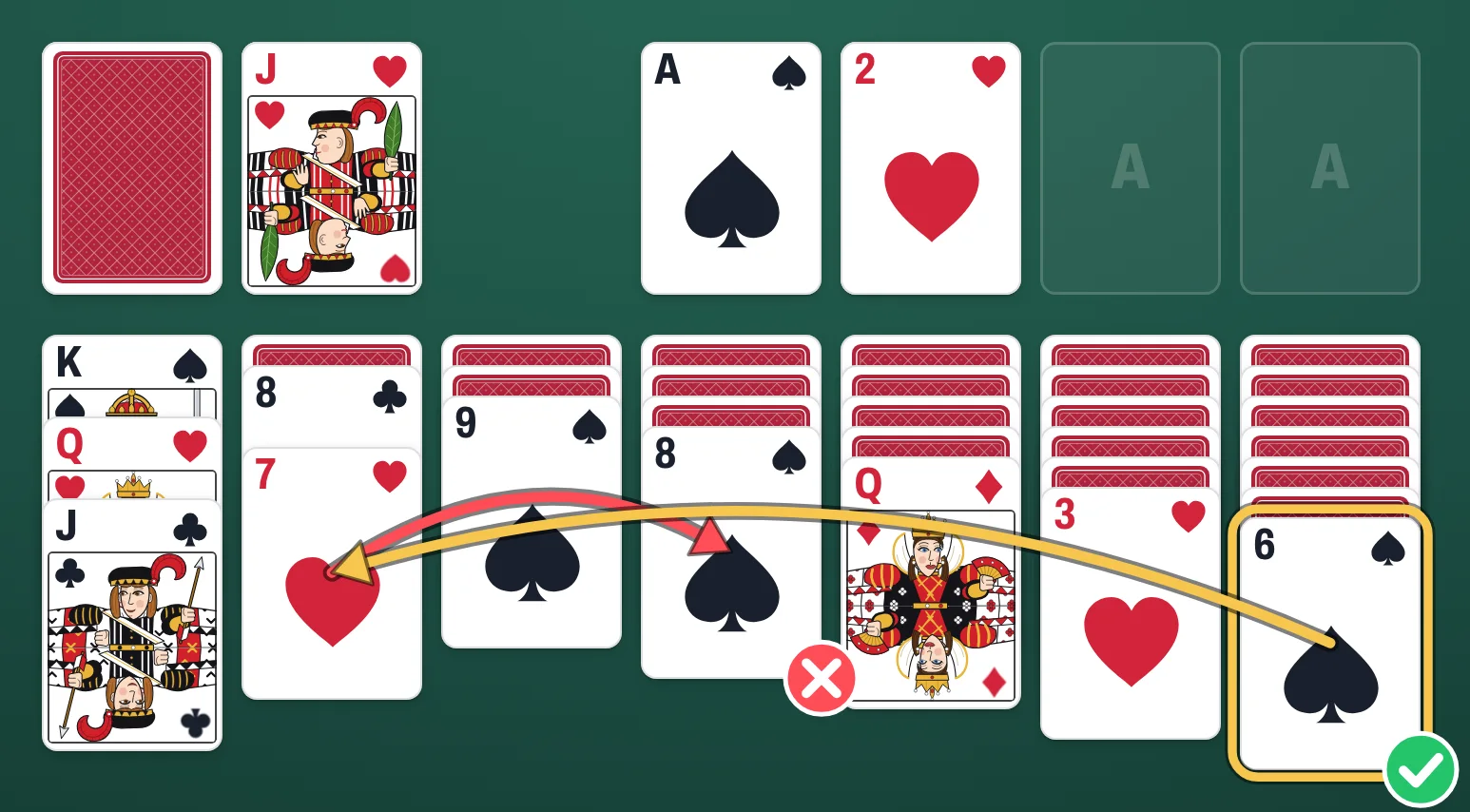
Most lost games of Klondike Solitaire aren’t lost to bad luck. They’re lost to a handful of habits that feel natural when you start out. Here are the ten we see most often, each with what to do instead. Try them in the game on our home page or on the Klondike page.
1. Playing the first move you see
The table usually offers two or three moves at once, and the first one you spot is rarely the best. Before you touch a card, look at every column and ask what each possible move would uncover. A few seconds of looking wins more games than any trick.
Fix: make it a habit to list your options before each move. If two moves are equally good, choose the one that leaves you more choices afterwards.
2. Ignoring the face-down cards
Every face-down card is a card you can’t use yet. The game is really a race to turn them all over, and the 21 hidden cards in the columns matter more than the 24 in the stock, because the stock comes round again and the columns don’t.
Fix: prefer the move that turns over a hidden card. When two moves both do, choose the one in the column with the most face-down cards left.
3. Sending cards to the foundations too early
It feels like progress to put a card on a foundation, and Aces and 2s should always go up at once. Higher cards are different: a card in a column is also a place to put other cards.
Example: you can send the 5♥ up to its foundation, but the 4♠ is still waiting at the bottom of a column for a red 5 to sit on. Leave the 5♥ where it is until both black 4s are safely on their foundations.
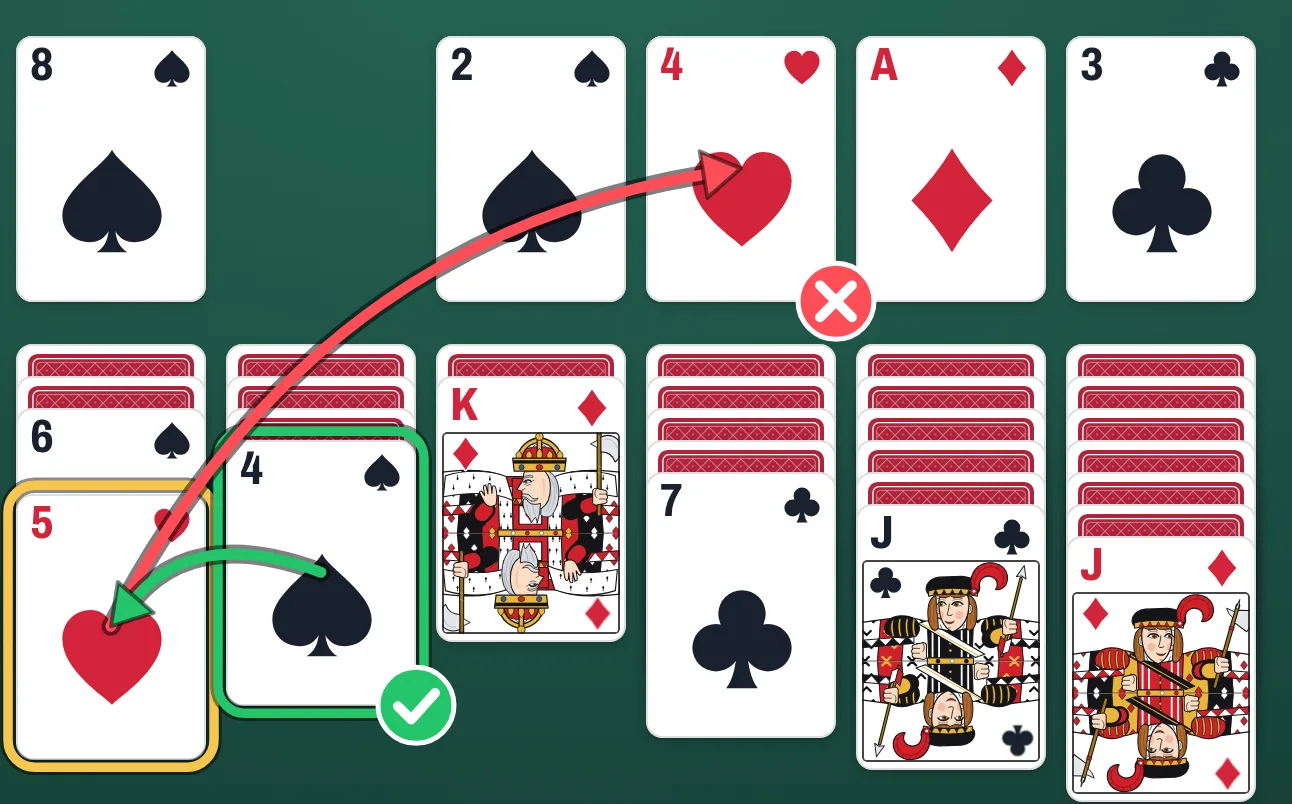
Fix: send a card up when nothing still in play could need it, which is when both cards of the other color one rank lower are already on their foundations. The Klondike strategy article explains this rule in more detail.
4. Emptying a column with no King to fill it
Only a King, or a run that starts with a King, can go into an empty column. Clearing a column feels like a big step, but if no King is ready to move in, the space does nothing for you, and the cards you moved to make it may now block others.
Fix: before you empty a column, know which King will fill it, from a column or from the stock.
5. Choosing the wrong King
When a red and a black King could both fill the space, the choice decides which Queens and Jacks you can use later. A black King needs a red Queen, then a black Jack. If the red Queens are buried and a black Queen is ready to play, the red King is the better choice.
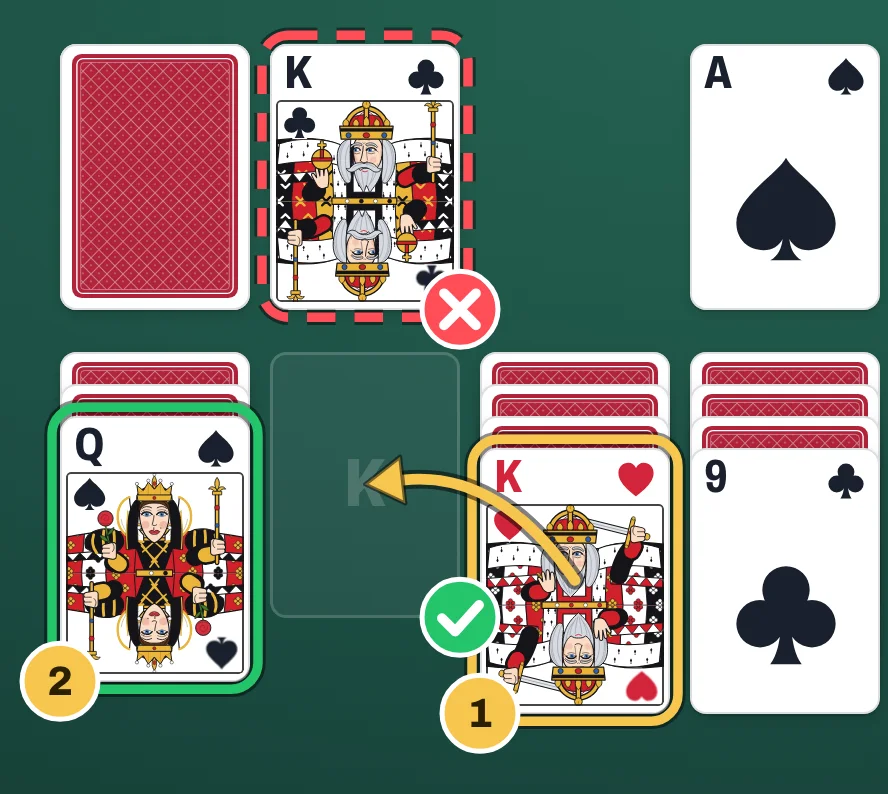
Fix: look at the Queens and Jacks you can already see, and choose the King that they can build on.
6. Turning the stock before playing the columns
Beginners often reach for the stock as soon as they start. The stock will still be there in a minute, but a move in the columns can turn over a hidden card, and a waste card you play changes what the stock shows on later passes.
Fix: make every useful column move first, then turn the stock. Once the stock gives you a card, check the columns again before turning the next one.
7. Moving cards just because you can
Moving a red 7 from one black 8 to the other, or a run from one column to a matching one, looks like activity but changes nothing, unless it turns over a hidden card or frees a card you need. Such moves can even cost you, by covering a card you will want to reach later.
Fix: for every move, be able to say what it gains you. If you can’t, look for another move.
8. Forgetting the longest columns
The column on the right starts with six face-down cards, the one beside it with five. Beginners often work on the short columns on the left because they are easy to clear, while the cards they need most stay locked on the right.
Fix: whenever you have a choice, work on the columns with the most hidden cards.
9. Starting with Turn 3
Turn 3 is the traditional game, and many players start there. But turning three cards at a time leaves two of every three stock cards out of reach, so it is much harder, and it hides the reasons a game was lost. Our article on Turn 1 and Turn 3 explains the difference.
Fix: learn with Turn 1, where every stock card comes round on every pass. Switch to Turn 3 once you win Turn 1 games regularly. Tap New to choose the mode.
10. Not using Undo and Hint to learn
Some players see Undo as cheating. In fact it is the quickest way to learn. When you reach a dead end, go back a few moves and try the other choice: you’ll see which decision cost you the game.
Fix: use Undo to test ideas, and press Hint when you can’t see a move. Not every deal can be won, so if the game tells you no useful move is left, undo a few moves or deal again without feeling you’ve failed.
Putting it together
The ten fixes come down to three questions to ask before every move: what does it turn over, what does it give up, and what will I do next? Ask them for a few games and they soon become automatic. When you’re ready for more, try the strategies in Klondike strategy: 9 practical ways to win more games, or put the same thinking to work in FreeCell, where every card is face up from the start.